

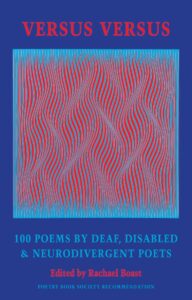
I was struck by the cover design of Versus Versus: 100 Poems by Deaf, Disabled & Neurodivergent Poets, a new anthology from Bloodaxe Books. I did not so much look at it as fall into it. The red was restless, the blue receded, the lines pulsed at a frequency I could almost hear. Designed by Neil Astley and Pamela Robertson-Pearce, it suggested a feeling: mobile. Everything refused stillness, resisted being smoothed over. Like the works inside: poems that refused containment, that arrived in waves, splintering, alive.
What one sees in these poems, the anthology editor Racheal Boast summarizes in the Introduction as the logic of “versus versus”; in duplicity, one thing cancels the other, and what remains is the opposite of opposition: “being together in concurrence.” To be versus versus is to make room for what has been othered, what has been cast into what Fanon calls the zone of nonbeing. The anthology flourishes in precisely that realm, as presences that alter the field of normalcy itself. They move against the grain of what poetry is often asked to perform, refusing decorum. They speak away from the margin, toward the center, and this I find a hallmark of novelty.
The discourse on disability has long been bent out of shape, toward pathos, toward pseudo-inspiration, toward pathology and misdiagnosis. Khando Langri’s “Medicine mantra for the road” opens like a guidebook: “go lightly (like this)/ to the frayed edges of place.” It gives the reader a mantra for the journey: “the sound that renders/ silence a parable.” To read this anthology is to “unspool the map” and pull “its threads (apart)/ for rope.”
Silence here is not absence. It is not lack. It is presence, a modality of language these poets return to, turning it again and again into wonder. Like in Torrin Greathouse’s “Essay Fragment: Medical Modality of Disability.” The word “disability” appears only as a strike-through in the poem, erased at the surface of text. The disabled body is described as “closest to machine/ in its dysfunction,” as “an abnormality,” as “a weight on society.” What else could mark such systemic silencing but silence itself, wielded here as the very grammar suited to the discourse these poems insist on carrying?
It is striking how the quality of silence coheres with the absence of sight. In Jen Campbell’s “First Thing, I Am a Forest,” this code writes itself, where what remains unsaid outweighs what is spoken. At its start — “when I wake up and I cannot see, I reach” — two kinds of seeing are held in tension: the inner seeing of the mind in sleep, and the outer seeing of the body roused from it. The gesture of reaching, placed at the threshold of the line, marks the potential embedded in this void: to reach is to extend beyond what is visible, to move into a field that does not depend on sight at all. Consequently, even when there are “webs stuck to my eyelids,” the speaker is able “to wear/ a rain jacket in an attempt to escape/ this weathering.”
According to the laws of normative function, the eyes are to see, the mouth to speak, the ears to hear. Yet in these poems, the body resists prescription. Its parts take on distinct functions, shifting with experience and context. In John Lee Clarke’s “At the Holiday Gas Station,” the speakers “see/ With our hands” and fingers are “walking.” In Linda Hogan’s “When the Body,” the body can “speak from the hands.” Once again, language is redistributed. Sight is not confined to the eyes, nor speech to the mouth. The body makes other grammars possible.
Illness in Versus Versus takes on many textures, physical and symbolic. Predominantly, the “illness” of being out of place with Ableist norms is towering. To be anything but “normal” is to be at once hypervisible and invisible. In Tito Rajarshi Mukhopadhyay’s “Misfit,” it is to be stared at, again and again, by passersby who label you by that word. In Lateef McLeod’s “I Am Too Pretty for Some Ugly Laws,” it is to be erased through policy, to be “scrubbed / off the public pavement.” But worse, still, it is to be categorized “ugly.”
In consumerist culture, beauty is currency: high cheekbones, long skinny legs, smooth freckle-free, acne-free skin on the front pages of magazines. To be ugly, however, is to be effaced, almost as surely as death. Such “ugliness” is in fact near-“sinful,” a crime punishable by law. McLeod writes about these Ugly Laws, where “any person who is/ diseased, maimed, mutilated,/ or in any way deformed” is considered “an unsightly or disgusting object,/ an improper person to be allowed/ in or on the streets, highways, thoroughfares,/or public places in this city.”
But McLeod nods to other voices resisting such blanket categorizations, each in their own register. McLeod’s resistance comes in rewriting the very terms of beauty, overwriting policy so that the laws themselves become the disfigured ones, while the poet claims beauty outright. In Andy Jackson’s “Song not for you,” refusal arrives through irony, through humor. The speaker mimics the patronizing voice:
When I walk or shop, I’m inspiring,
it seems. Fantastic to see you getting
out, you say, as you imagine waking
up in my body.
The speaker reclaims agency: their life is not an inspirational poster, not a vessel for others to draw hope earmarked by pity. Indeed, the melody of their life, the song itself, is “not for you.”
In Jack Mapanje’s “Skipping Without Ropes,” resistance takes the form of improvisation. Even when life has dealt the speaker a hand without ropes, the decision is: “I will skip without your rope.” In place of rope, there is “forged hope.” The skipping itself is a symbolic movement through the “silly rules” and “filthy walls” imposed by ableist norms. What was meant as deprivation turns, here, into motion.
There is also a diversity of era and experience here, drawing on the works of such historical figures as Abdullah al-Baradouni, Riyad al-Saleh al-Hussein, Paul Celan, Badr Shakir al-Sayyib, and Shiki Itsuma, among others, as well as contemporaries like Ada Limón and Ilya Kaminsky. African poets also appear: Kwame Dawes, Chisom Okafor, JK Anowe, Jack Mapanje, Sarah Lubala, Iyanuoluwa Adenle. Their inclusion unsettles the old trope that African poets are summoned only as representatives of socio-political struggle. Here, their voices enter a discourse still thin across the continent, still neglected.
The African poets are in dialogue with the malaise of memory and bodily unrest. JK Anowe’s “a musical malady” is akin to a fever dream of recollection, where the head “sings of a departure of all reasoning,” a song lodged inside every word, waiting to fracture. Memory here is a sickness, an appetite, a thing that resists containment and insists on consumption. The speaker fills a book with the word remember only to underscore how fragile the act itself is, how quickly it dissolves into longing. Images of goats returning to their young, of a mother’s daydream of shutting the door on her spouse’s toe, of a father’s “dust-feet at the thresh-/old” extend this unrest, this scattering. The final vision is brutal: a grand piano in a field, a finger nailed to its single key, blood dripping, the only possibility of sound. Music plays out as violence. Memory returns as pain.
The discomfiture reverberates. With Chisom Okafor’s “In another life, I am twenty-two, gifted and curious,” the split self dreams of escape, one figure waiting at the far end of the sea, the other trapped in the body, seeking to understand “the exquisite mathematics of drowning.” In Sarah Lubala’s “6 Errant Thoughts on Being a Refugee,” memory reduces itself to what the body cannot shed and home shrinks to “a narrow bed.” In “Skipping Without Ropes,” Jack Mapanje improvises the body against lack, moving it with nothing but “forged hope” against the walls of ableist decree.
Versus Versus illuminates a larger disquiet: to live in bodies deemed misfit, displaced, or impaired is to live with unrest that is intimate and historical. It is the unrest of memories scattered across continents, generations, bodies, and climes. In their refusal to contain it, these poets reveal the possibility of new grammars through which deaf, disabled, and neurodivergent people can speak back to the world and claim their places. ♦
If you love what you just read, please consider making a PayPal donation to enable us to publish more like it.
Buy the novel by Afabwaje Kurian. Open Country Mag may earn an affiliate commission.
- Versus Versus: 100 Poems by Deaf, Disabled & Neurodivergent Poets (Bloodaxe Books, 2025)
More Essays & Book Excerpts from Open Country Mag
— Introduction to the 60 Notable Books of 2025, by Tolu Daniel
— The Ahistorical Racial Polemic of Conclave, by Otosirieze
— Thinking Through Tremor, by Reyumeh Ejue
— “Our Literature Has Died Again”: Nigerian Writing in the Era of the Nomadists, by Kanyinsola Olorunnisola
— River Spirit, by Leila Aboulela
— “The Nigerian Oppression, as Chinua Achebe Would See It,” by Emmanuel Esomnofu
— The Quality of Mercy, by Siphiwe Gloria Ndlovu
— Between Starshine and Clay, by Sarah Ladipo Manyika
— “Revel, Again, in the Beautiful Absurd,” by Ernest Ogunyemi
— Black and Female, by Tsitsi Dangarembga
— Sankofa, by Chibundu Onuzo
— We Once Belonged to the Sea, by Diriye Osman
— Biracial Britain: A Different Way of Looking at Race, by Remi Adekoya
— The Fugitives, by Jamal Mahjoub