

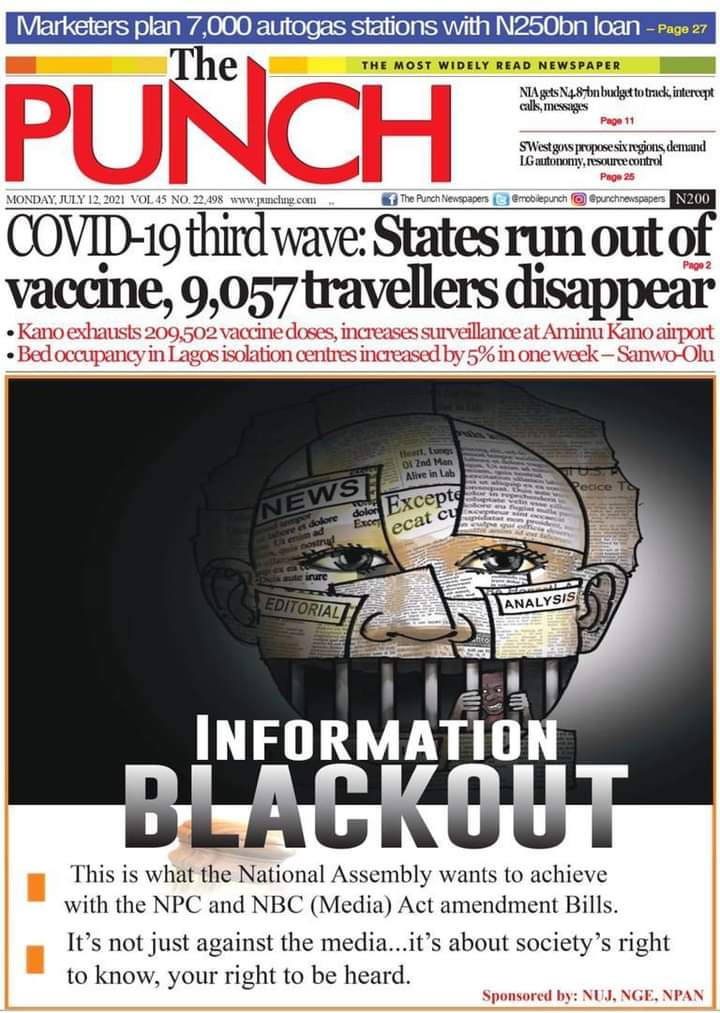
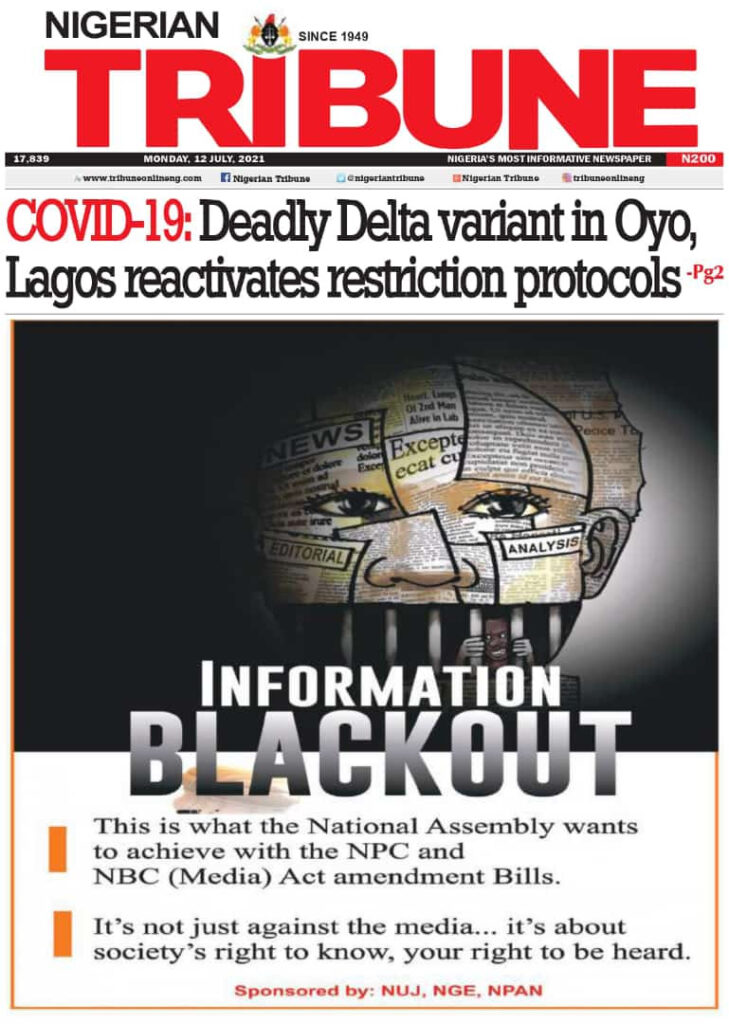
On Monday, 12 major Nigerian newspapers published an editorial condemning the media regulation bills in the National Assembly. The front page of dailies including The Nation, Punch, Vanguard, ThisDay, The Guardian, Daily Sun, Business Day, Leadership, and Nigerian Tribune had a human face with caged bars for mouth, and the phrase “INFORMATION BLACKOUT” in bold. The protest went on for two days, ending today.
The mass action was prompted by the Nigerian Union of Journalists (NUJ), Nigerian Guild of Editors (NGE), and the Newspaper Proprietors’ Association of Nigeria (NPAN). “It’s not just against the media,” they wrote in a caption. “It’s about society’s right to know, your right to be heard.”

The NUJ, the NGE, and the NPAN state that the Nigerian Broadcasting Commission (NBC) and the Nigerian Press Council (NPC) Act amendment bills are moves meant to stifle the freedom of the press. The latter bill gives the President the right to appoint the Chairman of the Board of the NPC, as well as other members of the board on the recommendation of the Minister of Information.
The NPAN explained why such bills were dangerous to the democracy of Nigeria: “It confers on the Press Council the power to determine ethics and fake news, investigate infractions and impose fines on journalists, publishers and distributors. It proposes fines of up to N2 Million on the journalist and N5 Million on a corporate body. It specifies jail terms of one to three years and fines ranging from N.25 Million and N5 Million on journalists, newsagents and media outlets.”
Already at the public hearing stage, the bills are sponsored by Olusegun Odebunmi, Chairman of the House of Representatives Committee on Information, National Orientation, Ethics, and Values.
In a statement, the Human Rights Writers Association of Nigeria (HURIWA) praised the newspaper publishers for taking a stand. “Every right thinking lover of freedom globally should be exceedingly proud of the publishers of leading national dailies in Nigeria over the page one protest,” HURIWA wrote in a statement.
Attorney and human rights activist Femi Falana also condemned the proposals. “The Buhari regime has subjected journalists to trial under the Treason Act, while others have been charged with treasonable felony,” he said in an interview with Punch last month. “Scores of journalists and other critics are standing trial for embarrassing some state governors. The National Broadcasting Commission has been used to close and suspend media houses and impose outrageous fines on them.”
Nigeria is ranked 120 out of 180 countries on the World Press Freedom Index, dropping five places from its 2020 ranking. According to Reporters Without Borders, “Nigeria is now one of West Africa’s most dangerous and difficult countries for journalists, who are often spied on, attacked, arbitrarily arrested or even killed.” ♦
If you love what you just read, please consider making a PayPal donation to enable us to publish more like it.
In-depth Stories from Open Country Mag
— Afabwaje Kurian Grows Her Gbagyi Roots
— The Digital Crusades of Ikhide Ikheloa
— Ikenna Okeh’s Quest for Authenticity
— “Little Did We Know”: How uHlanga Press Disrupted South African Poetry
— In a Time of Fire, Chuma Nwokolo Protects His Purpose
— A Navy Pilot Pivoted to Writing, Spurred by Surrealists
— How Damilare Kuku Topped Nigeria’s First Ever Bestseller List
— A Poet’s Walk of Pain Ends, Finally, in Acclaim
— The Mystery of Sofia Samatar
— In Conversation with Lan Samantha Chang, Director of the Iowa Writers’ Workshop
— Where Diriye Osman Draws His Flamboyance From
— Shugri Said Salh on Writing Her Life in the Somali Desert
— Kakwenza Rukirabashaija on Being Jailed and Tortured in Uganda
— A Novelist Entered Literary Curation, Still Honouring Her Feminist Roots
— Mark Gevisser’s Long Mission of Queer Visibility
— Hannah Chukwu’s Call to Help Uplift Unheard Voices
— For 13 Years, Nigeria’s DSS Targeted Novelist Okey Ndibe. Now, He Might Push Back.