
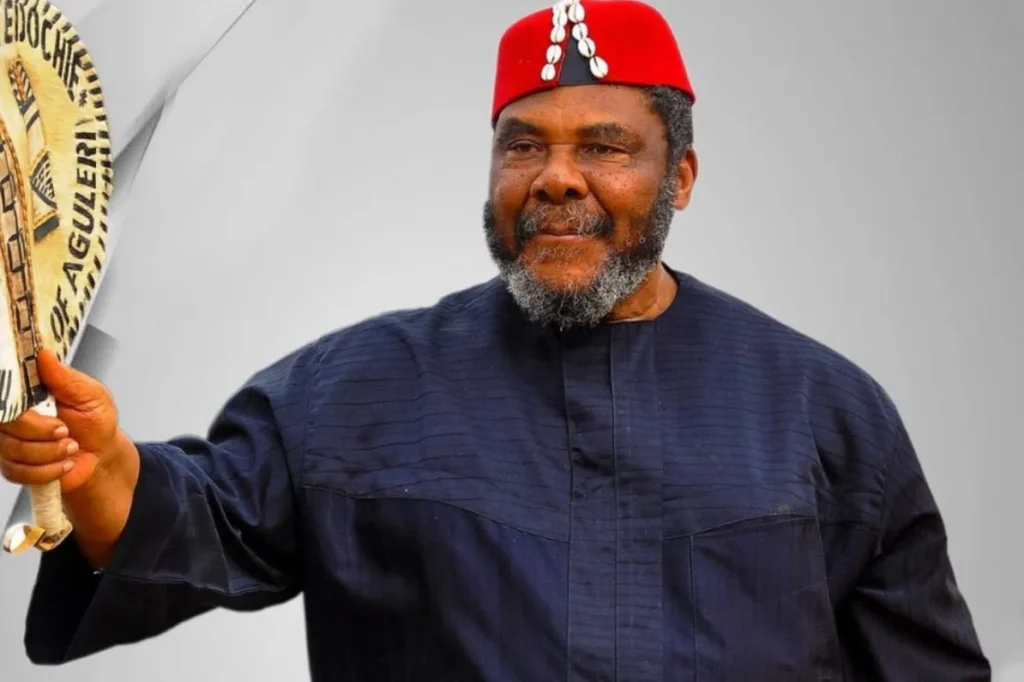
Pete Edochie, who through decades of legendary screen success, dignified cultural fame, and witty proverbs established himself as the patriarch of the Nigerian cinema era of Nollywood and a revered model of Igbo and Nigerian masculinity, has died at the age of 79.
In a statement signed by his son, Chief Leo Pete Edochie, the veteran actor and broadcaster “departed this life on Wednesday, 25th November 2026 at 12.30 am after a protracted battle with prostate cancer in Enugu, Nigeria.” Another statement, signed by Ada Kris on behalf of his management, described his passing as a “transition to glory”: “An Iroko has fallen. His legacy, however, shall endure for generations.” It requested that the family’s privacy be “accorded the utmost consideration during this period of grief.” Funeral arrangements, it said, would be communicated in due course.
Born on 7 March 1947, in Zaria, Kaduna State, to a generation that helped make Nigerian screen productions familiar to audiences beyond the country’s borders, Edochie hailed from Akamnato, Ifite Nteje, Anambra State. Before becoming one of Nigeria’s most recognisable actors, he built a career in broadcasting. In February 1967, he joined the Eastern Nigerian Broadcasting Corporation as a junior programmes assistant. He also served as Director of Programmes and Deputy Managing Director of the Anambra Broadcasting Service.
In 1987, he took on the role of Okonkwo in the NTA-BBC adaptation of Chinua Achebe’s 1958 novel, Things Fall Apart. Interestingly, Edochie had not read the novel before encountering the story through the adaptation’s script. Recommended for the role by a former colleague, G. C. Ugwu, he auditioned at the University of Nigeria’s Enugu campus, where his reading impressed the production team. The performance would eventually bring him recognition beyond Nigeria, with the BBC travelling to interview him following the adaptation’s success.
As Nigerian cinema developed through the home-video era and eventually into the industry now known as Nollywood, Edochie remained a house-hold name. He appeared in films including Rituals (1997), Igodo (1999), and Billionaire’s Club (2003), where he mostly played characters of wealth and power, from kings to billionaires to murderous villains. His performances are remembered for their deep proverbial dialogues. In Genevieve Nnaji’s Lionheart (2018), he played Chief Ernest Obiagu, the head of a family-owned transport business whose declining health brings questions of succession and family loyalty into the running of the company.
“Pa Pete Edochie was my favourite actor growing up because he carried himself with such dignity and gravity,” said Open Country Mag founder Otosirieze. “The only time I was privileged to meet him, in 2021, through three or four hours of business conversations, he had a whipping sense of humour and was aware of generational changes. Mostly, he was taken aback at what he saw as a lack of focus and discipline among younger people. This year, we were just in the process of securing him for a cover story for Open Country Mag because there is a big formally undocumented story here. He was our first real international screen star, and it came on the back of a book adaptation, Things Fall Apart. Consider the significance of that in an industry that desperately needs to but just does not adapt books. In the Nollywood era, no one has done more for indigenous figurative language than him. How many people can say they built their fame on the delivery of proverbs? He may have mostly played kings and murderous wealthy men, but I think that he chose his characters to give a sense of who we have been as a country. No public figure’s death will haunt me more than his, because we have lost so much more than a patriarch. We have lost an archive of film and Igbo culture.”
His contribution to Nigerian entertainment received several recognitions. In 2003, he was conferred with the national honour of Member of the Order of the Niger (MON). He also received the Industry Merit Award at the Africa Magic Viewers’ Choice Awards in 2014 and a Lifetime Achievement Award from the Africa Movie Academy Awards.
His death comes two months following the passing of his colleague and friend, Olu Jacobs, the industry’s other patriarchal figure. In February this year, Edochie and his family dismissed rumours of his death. Most recently, while visiting a friend and colleague in Ghana, the actor, who was confined to a wheelchair, said that walking had become a problem for him, and he prayed that God would take him before he became a burden to the people around him.
Pete Edochie is survived by his wife, Barrister Josephine Edochie, his children, including Nollywood star Yul Edochie, siblings, grandchildren, and other relatives. The family is yet to announce funeral arrangements. ♦
“An ambitious new magazine”
— Chimamanda Ngozi Adichie
Subscribe for essential, in-depth stories in African literature, Nigerian film, & culture. From inspiring Profiles and thought-provoking features to incisive reviews and essays, gain premium access to the visions of changemakers, from icons to emerging voices, and critical conversations that happen nowhere else. Plus key industry stories from Folio Nigeria by CNN.
We respect your privacy and will never send you Spam or sell your email.
If you love what you just read, please consider making a PayPal donation to enable us to publish more like it.
Cover Stories from Open Country Mag
— How Wole Soyinka Inherited the Drama of the Gods — and Shadowed the Nigerian Tragedy
— Chude Jideonwo’s Stage of Nigerian Dreams
— The Creed of Cardinal Arinze
— How Leila Aboulela Reclaimed the Heroines of Sudan
— How Rita Dominic Became Nollywood’s Most Acclaimed Actor
— Chinelo Okparanta, Gentle Defier
— The Next Generation of African Literature
— The Methods of Damon Galgut
— Chimamanda Ngozi Adichie Is in a Different Place Now
— How Teju Cole Opened a New Path in African Literature
— Maaza Mengiste‘s Chronicles of Ethiopia
— How Tsitsi Dangarembga, with Her Trilogy of Zimbabwe, Overcame