
In the closing moments of A Tribe Called Judah, the procedural, wide aerial shots reveal a few flourishes. The sick heroine is fleeing with her sons, the surviving ones from a bank robbery gone wrong; as they climb into a motor-powered wooden canoe, a voice rings out from the edge of the frame: the lastborn son’s girlfriend. She is running towards them, picks up a club and hits the family’s lone assailant on the head, and scurries into the water. As she sets her feet in the canoe, the film is only five more cuts and four kinds of shots longer.
Her climbing into the canoe is a full shot, roughly fitting the frame. Cut to a medium shot, of the upper part of the canoe, focusing on the people sitting in its belly; the camera set behind them, only down to knees; it lingers a few seconds longer than anticipated. Cut away from the canoe, at a low angle, to a closeup of a man ashore, the facilitator of the family’s escape — a gentle upward movement to reveal his fist raised in salute. Cut back to the medium shot of the canoe, a few seconds longer.
We are calmly let out of the scene by another aerial shot. It is a long take now, swooning far and above the canoe as it starts a turn, the camera following but also drawing back into the sky. The frames quicken as the turning canoe tails a C, the water rippling faster, then return to regular pacing. As the distance grows, the shot widens, until the river is a tea-coloured, snaky stream surrounded by green foliage, and the canoe at its heart is as tiny as a toy.
That final scene is the climax of the film, and when it premiered, a video circulated online of an audience reaction as the family escapes. The bated breath and cheers in that video partly explains why the film broke the billion-naira barrier at the Nigerian box office and became its highest-grossing film of all time. Its final N1.4 billion figure has since dropped to No. 4 on that list, and two of the three films that bested it — Behind the Scenes (N2.6 billion) and Everybody Loves Jenifa (N1.8 billion), both produced and co-directed by superstar Funke Akindele — were also edited or co-edited by the same person who cut the frames for A Tribe Called Judah: Valentine Chukwuma.

“A Tribe Called Judah has to be the movie I’m proudest of so far,” said the bright-eyed, soft-spoken Chukwuma, who worked on it alone. “Maybe future ones will take over that, but for now it’s A Tribe Called Judah, because of what it has: action, heist. I have always wanted to do action for a very long time, and, also, I have seen the reaction of people and how the reception was like.”
We spoke on the phone in early December, before the premiere of Behind the Scenes, which Chukwuma co-edited with Adio Solanke. That film crossed the N500 million mark in only 12 days, the fastest Nollywood film to do so, and became, despite being released in the middle of the year’s final month, the industry’s top grosser of all time. This year, it passed the N2.5 billion mark. Much has been made about Akindele’s golden touch, but little about Chukwuma, who has accompanied her in her billion-hopping era.
He had earned Akindele’s trust during the making of Omo Ghetto: The Saga, the 2020 gangster comedy film that first reached the all-time No. 1 with N636 million and is now No. 6. Something had gone amiss in post-production, and the team could not tape the sound to the visuals. Chukwuma, in shirt and tie, came into the room and offered to help. It was a dash of self-belief and boldness.
“I told them I could do it. I said, ‘Oh, I can do this.’ But of course, I did not know how to,” he said.
All night, he stayed up and researched how to fix it, and, the next day, he did. The film’s co-director, the rapper JJC Skillz, was impressed. Although Chukwuma was working on some episodes of African Magic’s My Siblings and I, JJC Skillz told the young intern to keep on with the film, sharing duties with Adeyemi Adeshomade. The three are credited as editors.
Upon release, industry chatter focused on Omo Ghetto: The Saga‘s N189 million opening week gross, the first Nigerian film to cross N99 million in an opening weekend, but the quieter victory was its nominations for editing at both the 2021 African Movie Academy Awards and the 2022 Africa Magic Viewers’ Choice Awards. It was the big break for its unknown saviour.
“Luckily” was how he described the moment. “I never even expected that.”
Akindele has five films in the top 10 highest grossers of all-time — including 2022’s Battle on Buka Street (N670 million) at No. 5 — all projects from her Scene One Productions, raking in an estimated N7.2 billion. What is not widely known is that Chukwuma edited or co-edited all five; that he evaluated all the raw footage from all those films, chose the best takes, arranged the scenes, set the pacing, modulated every visual and sound element and blended them all into the coherent vision of the directors that we see onscreen.
He worked on Everybody Loves Jenifa with Israel Odunsi and on Battle on Buka Street with Kayode Aransiola. He is a key cog in the formidable Scene One machine, a team that includes the screenwriter Collins Okoh, who has held the box office record for Nollywood screenwriters. That synergy has brought critical acclaim as well. Battle on Buka Street, for 2023, and A Tribe Called Judah, for 2024, were both named in Open Country Mag‘s annual list of the best films.
“For me storytelling really happens in the edit,” Chukwuma said.

Valentine Chukwuma learned to solve problems earlier than most. Born on Lagos Island, he was taken in by an uncle in Surulere when he was only two years old. The uncle, “who was living a bachelor’s life,” was always out and left daily food stipend for young Chukwuma. Every day, the boy had to decide what and when to eat. It would be almost a decade later before he set his eyes on his parents again, after they relocated from Lagos to Ilorin, and live with them.
His dreams growing up were not in film but in modeling and medicine. When he did not gain admission to study Medicine, and with his parents not being financially buoyant to sponsor it, he opted for Computer Science at Federal Polytechnic, Oko, Anambra State. There, he discovered video editing.
“There’s this course we did in 300, 400 level; it’s called ‘Multimedia.’ Our lecturers, what they did was they gave us a project to make media content. And, you know, as guys now, we wanted to make money. I was, like, ‘Okay, this is a perfect time to make money.’”
He began browsing how to shoot and edit video content.
“Luckily, my course mates that I edited for, they were having high grades,” he said. “Almost everybody that I did the media thing for, they got an A. I was, like, ‘Okay, I think I have something in here.’”
He and his friends started making skits, with him editing and directing.
Back in Lagos after school, he saw a vacancy for internship at Scene One Studio. The company was looking for a social media content editor. He applied. During the interview, he showed JJC Skillz the videos he edited for former course mates and the skits with friends, and he got the job.
Working there, he asked questions of the editors. Sometimes, when the editors were not in the studio, he played around with minor tasks. It was during one such moment that JJC Skillz found him.
“What’s going on?” the director asked. “You’re supposed to be working on your assignment.” Then he looked closer at the screen. “Is this your edit?”
Chukwuma said yes.
“Let me see.”
Chukwuma played it.
“I think you are going to be on sets from now on,” JJC Skillz said.
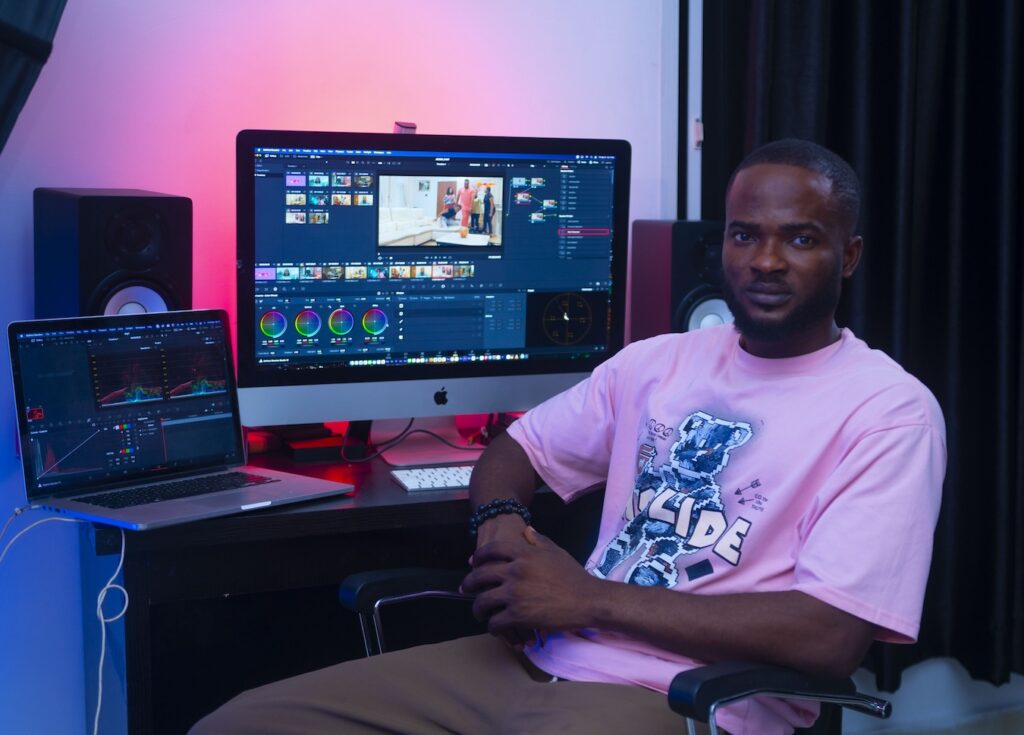
“The driving force was poverty,” Valentine Chukwuma told me about choosing film editing as a career, “because I just wanted to make money.” In a classist industry that hypes glamour over grit and neglects behind-the-scenes talents, and editing is an underdiscussed art, his name is going unnoticed, even as his work is the most visible. But if he is aware, he does not care.
Down-to-earth, unassuming, he in fact plays down his achievements. When I said on the phone, laughing, that he did not sound aware that he is responsible for five of the highest-earning Nollywood films of all time, he replied, laughing, “How am I supposed to sound?” After a brief pause, I said, “I hope that came out well, because I intend it as a compliment,” and he simply laughed.
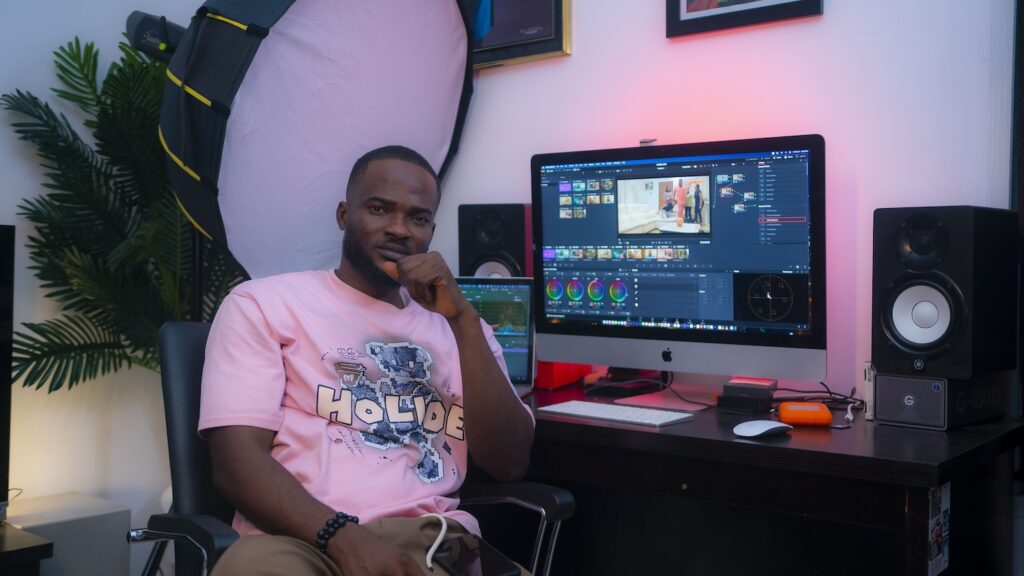
His office is a small white space with thick, black curtains, flooded with controlled light. The effect is clear, tinged with blue and soft red. A strobe stands in the corner, its softbox dish facing down the desk, ready to shine. Large potted artificial palm fronds stretch out beside a large-screen TV. On his shiny wood desk sits a 24-inch Mac monitor and two medium-size speakers. Hung above are two framed photographs. One is Chukwuma. The other is the Hollywood actor Will Smith. Behind this desk, on a swivel office chair, he works.
“My approach is the same as every other editor’s,” he told me in a second interview. “The first thing is to understand the script, the project, the film, then align with the director, know what he or she is trying to achieve. Because, obviously, it’s not your story; it’s the director’s story; it’s the producer’s story. Then you, as an editor, you know, ‘Okay, this is the style of editing to achieve whatever the director wants to achieve.’”
Most of his hits with Akindele are family films with different emotional premises: A Tribe Called Judah, Battle on Buka Street, and Omo Ghetto: The Saga. To explore their trappings, he tries to understand each character and “how they have come to be.” But they are also stories of different, overlapping genres. Omo Ghetto: The Saga is an action comedy, A Tribe Called Judah is a heist thriller, and Battle on Buka Street is a comedy-drama. How does he pace and oscillate between genres?
“What I do is I separate them at first so that I don’t get overwhelmed with a particular genre,” he replied. “After working with comedy, I go to heist. And personally, I’m an action kind of guy, I love action movies. And sound is a huge part [of these shifts]. So the sound editor plays a huge role in switching up genres.”

His expectations are modest, which is surprising for the highest-grossing Nollywood editor of all-time. Despite having worked with some of the biggest filmmakers, what he aspires to is more projects with younger filmmakers.
“Because we have a lot of younger talents out there that are very good,” he said. “Not that I don’t want to work with big names; I [just] think [the] young, young filmmakers will bring out the best in me, kind of. I think the legacy I want is just to [have] young editors in the future always refer to me and say, ‘Oh, this guy did something like this.’ I want young editors to see me as an example.”
If that final scene of A Tribe of Judah evokes relief, if that expanse of water and foliage from the camera’s bird’s eye view suggests endless possibilities, it is because Chukwuma preserved those feelings in the timing and pacing of his cuts. His style is neither flamboyant nor understated; it is only obvious enough for little flourishes to be noticed. He wants to elicit the right reactions in his audience, so he chooses clarity and leaves the frames clean enough to not hinder understanding.
“When, after doing a job, you go to the cinema on the premiere day, and you want the audience to react in a particular way, and you go there, and you see them react that same way, it’s satisfying,” he said. “It’s that feeling of ‘Okay, yes, I achieved what I was supposed to achieve in this project.’” ♦
If you enjoyed what you just read, consider making a PayPal donation to enable us to publish more like it.
No One Covers Nollywood and African Literature Like Open Country Mag
— Taiwo Egunjobi‘s Cinema of the Trapped
— Rita Dominic‘s Visions of Character
— The Epic, Transformative Comeback of Chidi Mokeme
— How Leila Aboulela Reclaimed the Heroines of Sudan
— Chinelo Okparanta, Gentle Defier
— The Next Generation of African Literature
— In Dika Ofoma‘s Short Films, the Drama Is in the Mundane
— How Dakore Egbuson and Tony Okungbowa Traverse Trauma in YE!
— With the S16 Film Festival, an Arthouse Collective Locks Its Focus
— How Tolu Obanro, Nollywood’s Top Composer, Crafts the Sounds of Its Biggest Hits
— The Methods of Damon Galgut
— Chimamanda Ngozi Adichie Is in a Different Place Now
— How Teju Cole Opened a New Path in African Literature
— How Mami Wata Swam to Sundance
— With Novels & Images, Maaza Mengiste Is Reframing Ethiopian History
— How Tsitsi Dangarembga, with Her Trilogy of Zimbabwe, Overcame