

Off the page, different concerns plague our livelihood. Sometimes, they present as ordinary and inconsequential, and other times, as global and moral. All of these are nonetheless existential. They shape our being, the way we navigate and make meaning of the world. Writers go to the page to tell the troubled stories that animate their ways into their lives, countries, and continents. These poets in 20.35 Africa Volume IX show the range of the existential crises faced in the world they live in, and they paint all the filth, beauty, and joy of it.
Star Zahra’s “Soot” opens the anthology with these lines: “When I close my eyes to the pleasuring / sound of rain drops dancing on the tin roof, / A child closes theirs / to soot.” — a poem that reconciles beauty and privilege with the suffering around us. It is arranged like a wall galleried with paintings, and while three of the five frames capture the simple pleasures of life, they are interrupted with differences from places and people who can’t have those pleasures. It begs the questions: Who gets to experience the beauty of living and who doesn’t? What’s the cost of this disparity? Soot?
This dark aftermath of burning and its threat to life recurs throughout this volume. Joemario Umana writes in “What the Road Refuses to Name” of a burnt vehicle by the roadside “crow-coloured and smoking, opens a door of fear / inside my body, how its windows reflect the half-moons / of men running from a country that keeps swallowing its own breath.” He confronts how a country’s failure has led to the constant death, kidnapping, and terrorizing of its citizens. Each line grapples with the danger of being in a place that refuses you the refuge of home, and the anxiety that comes with looking for death in everything. His other poem, “Sunflowers at the Mouth of a Closed Door,” contends with a similar struggle, the freedom and dreams of people stifled and hope gradually lost: “I do not know / how to stay loyal to a wound that keeps opening / its mouth… / Even heaven seems to be rationing light.” This juxtaposition of the bodily and place, and the doubt of “I do not know,” hold the poem’s core reality and the writer’s relationship with his country Nigeria.
This anthology is concerned with the body, the land, the harm and damage done to their soft expressions of life. In a time when the machine and industrial complex numb our relationship to the body and the earth, how do we as writers respond to the spiritual disconnection that ensues?
Aishat Yahkub captures well this bodily violence in her beautiful and inventive “Bodies. Bodies. Bodies”:
light, hollow, winged bodies
tethered only by memories bodies
bodies poised on red blade kn/life bodies
breakable, mourning, weary bodies
endless, birdless, limbless, colourless tree bodies
efflorescing, bullet-opened, bomb-caressed bodies
bodies curved with terror, braked, stilled
on screams bodies
The body becomes a thing erased and transformed into a small site for warring. It’s made ordinary (“sweet with ache, small, hungry”), tender (“light, hollow, winged”), but inflected with violence (“war, quenchless thirst”), and made plastic with grief (“breakable, mourning, weary”). We lose sight of the body as it becomes numbers bloodied by death’s hands.
In her other poem, “In the Painting, Bejeweled Palestine,” Yahkub continues interrogating the cruelty facing the body, and, in the last line, extends it to the land:
the suspended bombs freckling the sky’s intense blue
face, haloing her body, framed before impact,
look like starry gold gems, witnessing —
would this bed of brilliant green grass be made into another grave?
The painting Bejeweled Palestine might as well exist or not, but the world illustrated here is reminiscent of protestant art, capturing the reality of a place in both metaphysical and realistic standpoints. Perhaps the most haunting part of this poem lies in it being one sentence, stretching out the pain and hollowed war and destitution of a place and its bodies.
Most importantly, these poems remind us that the suffering in the world is inflicted by us, on us. “The shore returns what we have killed. / Says: / I have rolled my waters dry / to present you, your guilt,” writes Tonye George in “Elegy for Things Failed Twice.” Tonye’s poem resists abstract musings and theories of the origin of violence on everything living, keeps its language literal while looking at and calling violence back to its source: man-made. The natural world is turned to both witness and victim in the centuries of man-made destruction, historic lands of beauty pillaged, destroyed, and turned into graveyards. The poems critique the effects of our wars, colonialism, capitalism, and how the systems that drive all of these persevere.
In “El Fasher,” Fatima El Badri writes of the remnants of war and its effects on the titular city, the capital of North Darfur State in Sudan: “in bosom i hold an’ lick wound of city with tribeless tongue (unsiege an’ cry monsoon) (pull fruit from cracked depths).” El Fasher’s poem holds love, opens its tender arms to it, but also remembers, in its non-punctuated lines, the “spool of gunfire tongues twisting to break an’ steal children’s singing smiles wiped.” The continent and its people are still recovering; how do we then reconcile with the devastation that generations to come will inherit in their bodies?
But the ghastly disregard of human lives and the earth are not all these writers are occupied with. They also indulge the beauty of the everyday — cute glances stolen from either side of a bench, origin stories that make up childhood, desire for aesthetics, newness, fear of losing love. When Hana Meron writes in “Mengedegna,” “I finally understand… / knowing I didn’t have to / come so far to find myself, loving that I have. / Up here on the roof, there’s room: for beauty, for writing, for me,” one is immediately reminded of the journey of an artist as they find spaces that reflect back the beauty they express from within, spaces that will open as creative outlets. Creating art has always been a spiritual endeavour, tied to the natural world. The persona searches for mountains that feel like home, hills that let you see the shine of the world beneath, and waters that snake back to the ocean: “Everywhere, I am looking for the perfect place to write.”
There’s love in these pages. Sometimes it appears as a wish for comfort, as in Sarah Uheida’s “Let Me Let the Rosewood Rot”: “Either let me let the rosewood rot / or lend me a night of yours / to know your shoulder / with my chin.” The most endearing aspect of tenderness could be this, how it seems little but holds more weight and significance than it appears to. And Uheida’s poem enacts this with its yearning for more, for softness: “I do not mind pining / I do not mind poetry / I just need sleep / And you to love me back.”
Sometimes love in these pages is unabashed and transcends time and place, like in Mario Melo’s “A Caged Pastoral”: “It is loud and awkward. / We are loud and awkward, writing love letters / to prisoners. Extending sentences.” In these lines, we sit with loss and remembrance of love. Other times, love presents itself as a worry, of not telling a lover something. Seems simple, seems normal, ordinary, but a pressing anxiety regardless.
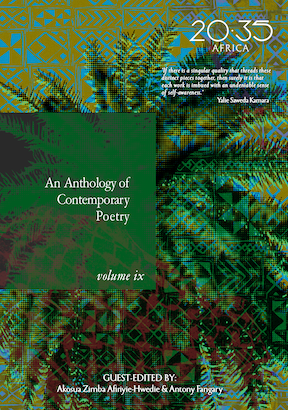
It is part of 20.35 Africa’s mission to establish that there’s no limit to the range of African poetics. Volume IX, comprising 17 poets from nine African countries, represents a share personal and socio-political experiences in the worlds they live in. There’s a comfort that comes with knowing the different ways that beauty and joy enter our lives and writing. Despite the terminal state of the world, it is a source of hope on its own that people find time to write, sit with their grief and try to make meaning of the senseless wars and destruction, find love and hold on to it, on and out of the page. These poems remind me that the thick layered air of exhaustion has not rid us of our resilience. Has not rid us of our dreams to right the current state of our lives and the earth’s. I hope that they speak to you the same way they have to me and my co-editors. ♦
20.35 Africa Volume IX, guest-edited by Akosua Zimba Afiriyie-Hwedie and Antony Fangary, is published online by 20.35 Africa.
If you love what you just read, please consider making a PayPal donation to enable us to publish more like it.
More on 20.35 Africa Poetry Series
— With 20.35 Africa, Ebenezer Agu Is Curating New Voices in Poetry
— Introduction to 20.35 Africa Vol. VIII, Guest-edited by Sarah Lubala and Logan February: “The Desired and the Divine”
— 20.35 Africa Vol. VII, Guest-edited by Kwame Opoku-Duku: “This Grasping for Hope Walks with Us”
— 20.35 Africa Vol. VI, Guest-edited by Nick Makoha and Safia Jama: “Creating a New Tradition in African Poetry”
— 20.35 Africa Vol. V: “An Adoption of Language to Contain This Violence”
— 20.35 Africa Vol. IV, Guest-edited by Nadra Mabrouk and K. Eltinae: “The Opportunity to Read African Poetry Along Language Aesthetics”
More Essays & Book Excerpts from Open Country Mag
— Can Contemporary Nigerian Literature Come Forth as Prophecy?, by Joshua I. Mokwuah
— OCM Presents: Essays from The Sabi Prize for Critical Reading and Writing
— Between Starshine and Clay, by Sarah Ladipo Manyika
— River Spirit, by Leila Aboulela
— Black and Female, by Tsitsi Dangarembga
— Disability and the Grammar of Presence in Versus Versus, by Iheoma Uzomba
— Introduction to the 60 Notable Books of 2025, by Tolu Daniel
— The Ahistorical Racial Polemic of Conclave, by Otosirieze
— Thinking Through Tremor, by Reyumeh Ejue
— “Our Literature Has Died Again”: Nigerian Writing in the Era of the Nomadists, by Kanyinsola Olorunnisola