

Introduction
At a time when Nigeria’s reading culture is increasingly imperiled, and serious thought is treated as indulgence, the Sabi Prize for Critical Reading and Writing is concerned with our most important constituency: young people. Its preoccupation follows an ugly diagnosis: less than 10% of the country’s annual budget is allocated to the education sector, while startling out-of-school population numbers (up to 18.3 million children, one of the highest globally), underfunded literacy initiatives, and persistent gender and regional disparities reveal a system sorely, and astoundingly, apathetic to its learning gaps.
So when Otosirieze shared that the founders, Dawn Chinagorom-Abiakalam and Chukwuka Odigbo, had proposed that Open Country Mag publish the winning essays, it seemed to me a necessary act of resistance: beneath the country’s stark educational failures are students who are reading closely, thinking critically, and writing with fresh acuity. I was excited to edit the essays.
The Sabi Prize is open to senior secondary school (SS1 – SS3) students resident in Nigeria, as well as homeschooled students and those taking a gap year. In Phase 1, entrants were asked to write an essay about an issue affecting their community and what they would do to fix it if they were in a position of leadership. For Phase 2, the students were asked to write an analytical essay in response to any two of four prompts drawn from Chapter 4 of Buchi Emecheta’s The Joys of Motherhood; their submission would examine colonialism, socioeconomic pressures, cultural conflict, and the demands of survival.
And here is what delights me most about this initiative: very rarely do we see literary pursuit by children awarded to this degree: ₦1,000,000 for first place, ₦750,000 for second, ₦500,000 for third, and ₦100,000 for each of the Top Ten finalists. It is a total of ₦2,950,000 ($2,165).
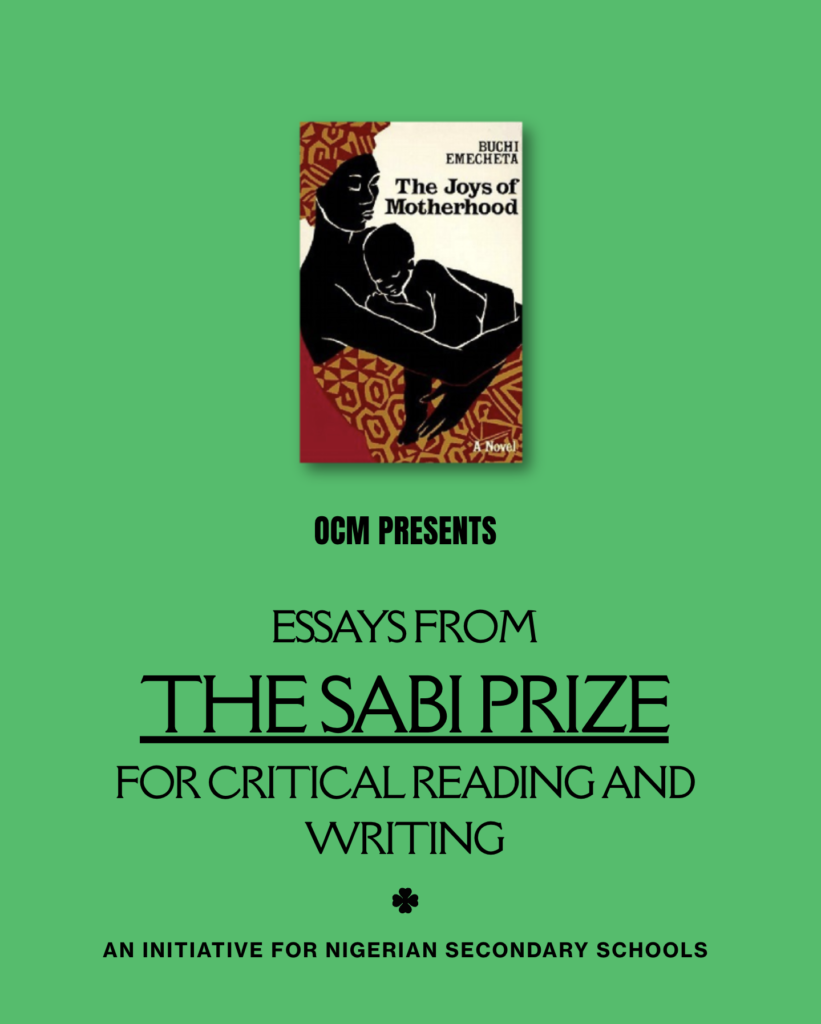
Of the 220 entries from 56 schools across 16 states, 65 students from 31 schools in 11 states advanced to Phase 2, from which the Top 10 emerged. Two acclaimed writers — O. Henry Prize recipient Adachioma Ezeano and Esther Ifesinachi Okonkwo, author of The Tiny Things Are Heavier, an OCM Best Book of 2025 honoree — judged the entries. They picked the top three essayists: Juanita Douglas-Jombo, Pearl Okereke, and Sekinat Agbeleshola.
Emecheta’s colonial Lagos is a rich site of inquiry, and these students prove suited to the task. In Chapter Four, the novel’s protagonist Nnu-Ego struggles to adjust to the harsh realities of urban life, hemmed in by the demands of marriage and motherhood, while her new husband Nnaife earns a meagre living as a domestic servant, leaving the family financially vulnerable.
In editing the winning essays, I sought to preserve the students’ voices, and the spirit of their work as budding writers. The edits therefore focused primarily on clarity, flow, and precision, whilst keeping their perspectives distinct. What makes these pieces compelling is not that they uncover novel postcolonial ideas: most of the concepts they engage with have been well-expounded on, albeit remain frighteningly relevant. The pleasure lies elsewhere — in seeing these ideas encountered anew by young Nigerians, and in witnessing students use reading as an occasion for thinking about the country they inhabit. Plus, a promising detail — in a nation where girls take up a disproportionate share, up to 60%, of its out-of-school population — is that the top three winners are all female.
Each of them approaches this world with keen sensitivity. Douglas-Jombo, who came in first place, reads the chapter as an account of “cultural dislocation,” in which indigeneity is crudely eclipsed by the religious and economic exploitation of British colonialism. First runner-up Okereke focuses more on Nnu-Ego’s heteronomy amid “the merciless nature of colonial labour.” Lagos reveals a malevolence Nnu-Ego is decidedly unsuited for, and Okereke animates the city as a callous, unfeeling thing, a microcosm of the wider cultural subjugation of the time. And in third place, Agbeleshola attempts a portrait of Nnaife that moves between insipid husband and unwitting victim of both colonial whims and Nnu Ego’s own (mis)understanding of masculinity. Across the three essays, there is an astute representation of the colonial condition and its erosion of intimacy and identity.
The Sabi Prize insists on reading, writing and curiosity in a zeitgeist that appears averse to it. In this flailing education system, it is exciting to see that young Nigerians remain resiliently intelligent, and are being rewarded for it.
The Top Three Essays
Third Place: “Pressed and Empty: The Dehumanizing Structures of Colonial Lagos in Emecheta’s The Joys of Motherhood,” by Sekinat Agbeleshola
Sekinat Agbeleshola, of City of Knowledge Academy, Ijebu-Ode, is a Year 12 scholar who has keen interests in African fiction and public speaking. As a student born in Lagos and living in Ogun, she has immersed herself in the cultural diversities of the two states. In her free time, she enjoys reading and critiquing diverse African texts. Her favorite books include Tomorrow Died Yesterday by Chimeka Garricks, Purple Hibiscus by Chimamanda Ngozi Adichie, and Gaslight by Femi Kayode. In the future, she wants to become a lawyer.
In traditional societies like Ibuza, men are constructed within a social patriarchy. They are built to be dominant, aggressive, proud, independent and selfish. However, Nnaife defies this traditional patriarchy and is portrayed as the opposite of Nnu-Ego’s “ideal man” — she deeply criticizes him and despises him for all he stands for: his physique, line of work, dressing, and the totality of his lifestyle. In her 1979 novel The Joys of Motherhood, Buchi Emecheta juxtaposes Nnu-Ego and Nnaife as contrasting elements to mirror the effects of Lagos’ social structure on people, as well as societal and marital expectations. Through their marriage and experiences, the author depicts Lagos as an element of change, and shows how Western influence is not violently imposed, but gradually seeps into the weaknesses of indigenous culture.
Nnaife is as much a product of Lagos as he is of tradition; the city shapes his routines, his priorities, and even his emotions, making him a man defined more by place than by personality. Nnu-Ego narrates her first night and morning with him where he is revealed in an inhumane light through his actions. He gives her no time to rest after a four-day journey, pouncing on her thereafter. The next morning, he does not bother to check on her, and instead tells her to cook, and leaves for work immediately. Just like a machine, Nnaife shows a lack of emotion, particularly empathy. Emecheta portrays Senior Owulum as a foil to Nnaife. Instinctively, he reacts to Nnu-Ego’s exhaustion and sympathizes with her; however, Nnaife ignores and proceeds for work, prioritizing duty over humanity. Through this, Nnaife exposes how Lagos rewards efficiency over empathy, and illustrates his loss of emotional instinct. Another instance further demonstrates this. His schedule gives him only half a day off on Sundays, leaving no time for him and his wife. Rather than rest, he is required to go to church by his employees. This suggests that Lagos absorbs even spiritual life into its economic labour, because even in moments meant for spiritual reflection, men are absorbed into routines by the same system that strips them of their humanity.
Similarly, Nnaife’s position as a washer-man reinforces the mechanical nature of his masculinity because just like the machine, he functions automatically and is at his employers’ every beck and call. Emecheta underscores this by detailing his movements: So regularly timed was his daily progression that one could tell the hour of the day by what he was doing. Emecheta’s use of the oxymoron “grand title” is also used to convey the irony and reality of his position. His work is subsidiary, repetitive and feminine as opposed to the patriarchal “pride” and “independence” of Ibuza men which Nnu-Ego expected. Nnu-Ego’s description of his soft, unimpressive body symbolically identifies with the machine he operates — a tool for repetitive tasks. Without fail, Emecheta uses Nnu-Ego’s pain towards her husband’s job and the tactless pride he takes in it — which she considers demeaning and too soft for a man — to mirror the lost sense of masculinity in Chapter four.
Simultaneously, if Nnaife is rendered a machine by Lagos, Nnu-Ego is forced to become his fuel. She mourns her idea of traditional, village love where lovers had time to linger over each other. She realizes that their work schedules in Lagos force them further apart. The tumult in Lagos leaves no time for such intimacy, as their basic needs would otherwise go unattended. Emecheta portrays men not as a literal description but a social metaphor. Through rigid economic structures and urban alienation, masculinity becomes mechanical rather than human. It strips men and women alike of their personal identity, pushing survival over compassion.
Equally important, Lagos’ geographic structures serve more as spaces of labour than actual homes. It creates an atmosphere in which relationships resemble business transactions more than mutual feelings and emotional connections. Predictably, Nnaife and Nnu-Ego’s marriage serves as a transaction: she wants a baby and he just wants a doormat wife. Moreover, the use of “exaggerated leave” for the neighbours’ exit after welcoming her reveals the exposure and vulnerability of her home structure as well as her lack of privacy in the space. On Saturdays she locks her doors which signifies her trying to carve out some sort of personal space and leisure for herself in the crowded urban space.
Furthermore, Nnaife rushes her to meet his community where she learns from the women how to start a petty trade business and earn some money to take care of herself. Soon enough, her business overrides her time because it soon becomes a necessity when Nnaife’s “machine-like” labour doesn’t actually provide enough. As a result of the routine-driven identity, her body fails to rest in key and demanding moments such as the pregnancy and labour for her first son, Ngozi, where she continues to work.
Chapter Four presents Lagos as not just any city, but an embodiment of economic struggle, time pressures, societal standards, and a driving force of the story. Emecheta shows how this urban exploitative setting makes men emotionally detached figures, driven by economic survival while losing morality. In other words, money is also an active tool that governs everyday life. It serves as a blindfold, an illusion. A false allure to draw men and women alike from their families and turn them into slaves for wages that glitter like fortune to them.
Ultimately, Nnaife remains a static character as he is unable to evolve from the structures and systems that tie him down and erode his sense of manhood, while Nnu-Ego is a dynamic character shaped by her experiences. Thus, in Chapter Four, Emecheta masterfully describes the geographic crowding and economic ruthlessness of colonial Lagos, which do not merely shape lives; they dismantle humanity, reprogramming men into unfeeling machines and reducing relationships to mere transactions.
Second Place: “The Lagos Life: Labour and Loss in Buchi Emecheta’s The Joys of Motherhood,” by Pearl Okereke
Pearl Okereke, of The Hillside School, Abuja, is a student writer currently residing in Abuja. She writes about fictional characters and contemporary issues. She has previously participated in the EFCC essay competition and the Cambridge Rethink essay competition. Her favorite books include Tomorrow I Become a Woman by Aiwanose Odafen, Adanna by Adesuwa O’man Nwokedi, and The Selection series by Kiera Cass. She is an aspiring diplomat and intends to specialize in international law.
In Buchi Emecheta’s acclaimed novel Joys of Motherhood, the suffocating and cruel nature of colonial Lagos is not one that manifests through chaos and strife. It is advertised as a land flowing with milk and honey, where the Black man and the White man stand on even footing, where all Nigerians have the chance to become someone. Only upon arrival do we realize that the reality is nowhere near as bliss and much more difficult to escape. Lagos life introduces itself under the guise of opportunity. It masks its tiresome conditions with the promise of survival. In the fourth chapter of the novel, we see that Lagos’ cruelty does not discriminate based on class, culture or gender; she is a ruthless mistress to whom all who enter must bow, turning men into “machines” and women into tools of compliance. Nnu Ego’s experiences as the wife of a “machine” show the cost of Lagos life, as well as the weight of colonialism, and how it is paid with the hefty currency of humanity.
In this chapter, we see that Nnaife is subdued by the energy and life force of colonial Lagos, making him a shell of a man and an unimaginable shock to his new bride Nnu Ego, a woman born and raised in the communal life of Ibuza. The narrow compounds, shallow spaces and constant noise fade into the background as Nnu Ego is faced with the reality of having to marry a man such as Nnaife, one she believes to not be a man at all. “They stopped being men long ago. Now they are machines,” a character says. This statement is a pivotal moment in this chapter, where the violent break suffered by Nnu Ego when she was brought to Lagos is put into words by her friend Cordelia. It also reveals the haunting observation that Nnaife has forever been altered by the life he lives while working under the white man.
Lagos, in this chapter, possesses an identity of its own. It is actively involved in the hardships of its occupants, from its physical structure, which is characterized by congestion and a lack of space, to its economic layout, which is built on constant servitude and a semi-permanent state of toeing the poverty line. In Nnu Ego’s new life, she lacks privacy, rest and peace in her domestic life. The city’s terrain is made up of restrictions, constantly weighing down on its inhabitants.
Although the chapter begins with Nnu Ego playing the role of dutiful wife, soon, even she succumbs to the weight Lagos’ economy lays on her family. The city is built to favour the colonizers, its economy built on the backs of the indigenous. These conditions are specifically formulated to exhaust Africans and strip them of their dignity, making them malleable towards the Europeans’ purposes. Men like Nnaife are victims of this cycle. His work as a washer-man leaves him no room for personal fulfillment or advancements in his domestic life. His wages are insufficient and this inadequacy forces him to continue the cycle of Lagos’ cruelty while leaving his family in want. Nnu Ego’s dreams of motherhood are riddled with anxiety by this new reality.
The intersection of Lagos’ geography and economy redefines family life. In Nnu Ego’s beloved home of Ibuza, children represent wealth, continuity, fulfillment, and prestige. In Lagos, children are nothing more than another mouth to feed. Lagos becomes a paradox, where traditional standards are ignored and hated in favour of fuelling a cash-driven economy. The city has no space for life — it only encourages survival and endurance. Nnu Ego soon begins to wonder who the force of Lagos would turn her into, how she would walk on this terrain without the help of her husband, and where her dreams of motherhood stand amidst all this. The power of Lagos had turned what was supposed to be a beautiful married life into a game of survival, with Nnaife as an unwitting catalyst due to his drive to survive.
It is under this context that Cordelia’s statement finds its power. This metaphor exemplifies the stark degradation of African men by the colonial labour systems. The traditional values which defined men by their nobility, strength of character, authority and responsibility have been forgotten, and, in their place, work and productivity-based ideologies have been put in place as the yardsticks used to measure how much of a man one is. The value of their humanity is replaced by the measure of their usefulness, and they become vessels made only for labour. This life ultimately drains their emotions and spirit, and in doing so, leaves them as “machines.”
This new identity impacts their lives, the lives of their families, and the lives of everyone around them. Exhaustion trumps affection. Routine replaces intimacy. Identity is drowned out by responsibility. The permanently restrictive nature of their physical environment, joined with the trap of their survival-fueled economy, leaves an ecosystem constantly working against and damaging itself. In this parasitic ecosystem, no human can survive. Only machines.
Titled “First Shocks of Motherhood,” Chapter Four observes the tension between traditionality and modernity, reflecting that one can rarely coexist with the other. Nnu Ego’s experiences under the economic and physical struggles of Lagos leads her to abandon her beliefs in ancestral blessing, communal support, and fertility, due to the fact that those beliefs offer little comfort in Lagos. Although she adopts a new faith in Christianity, the hunt for money replaces her spirituality, and her cultural dislocation enhances her sense of loss, as she exists in the space between a world she once knew and a new world she has no place in.
Ultimately, Lagos life is symbolic to the effect of colonialism all over Nigeria, the merciless nature of colonial labour, and the alienation from one’s own culture caused by the Europeans in Africa. In a matter of weeks, Nnu Ego’s opinion of men — which had been set high by her father, Agbadi, the last of the great hunters — had been reduced to considering them as mere machines. She is also faced with a system that strips individuals of their joy and dignity, forcing them to pay for their survival with the essence of their soul. When a man is stripped of his very soul, what then remains?
First Place: “Survival Over Autonomy: Colonial Pressures in Emecheta’s Nigeria,” by Juanita Douglas-Jombo
Juanita Douglas-Jombo, of Lycée Français Louis Pasteur de Lagos, is an SS3 student born in Port Harcourt and living in Lagos. When she’s not teaching herself to draw, sing or write, she’s reading up on world history and fiction. Her favorite books include Things Fall Apart by Chinua Achebe, Death Comes as the End by Agatha Christie, The Magician’s Nephew by C. S. Lewis, and The Secret of Moon Castle by Enid Blyton. She aspires to be an international lawyer.
Chapter Four of Buchi Emecheta’s The Joys of Motherhood explores the dynamics of colonial exploitation through religious means with the struggle of a yielding populace. Much like the country during the colonial era, the Nigerian people served merely as a means to an end— there was no vision for this territory’s future, as its only function was to serve as an economical cornucopia of natural resources and labour. The Nigerian people were an assembly of vessels to be imbibed with religious values that the White man couldn’t be bothered to follow himself. The question of obstinacy was non-existent, and the subdued people were all too ready to kowtow before their masters and follow any unknown God at their behest. Chapter Four exposes the deplorable state of colonial Nigeria: A British territory only worth its arable land, and a people reduced to instruments of economic exploitation and religious indoctrination, who have no choice but to value survival over autonomy, highlighting the hypocrisy of colonial rulers.
Dr. Meers and Mrs. Meers are representative of the colonial master in this example. Dr. Meers is seemingly accomplished, with many workers to tend his home and a job at the Forensic Science Laboratory in Yaba. Mrs. Meers, his wife, keeps the house in order, instructing the workers. Both have a distinct air of distaste for the indigenous people, but Mrs. Meers is more tactful about it. In fact, hers is more patronizing, even having a certain “air” and voice with which she addresses the natives. She tries to stand up for Nnaife upon her husband’s insults, but this does little to appease Nnaife, who sees her as insolent and disrespectful to her husband. Dr. Meers calls Nnaife a baboon, deriving a sadistic pleasure from an insult he knows the native will not comprehend. The old couple, despite being at loggerheads, represent two sides of the same coin — both see themselves as superior to their workers, and while one tries to show them some grace, she still fails to recognize that she is an enabler in the exploitative system, which is something her husband couldn’t be bothered to acknowledge.
Ironically, the couple embody the opposite of what they enforce upon their workers. The employees must go to church and learn the Christian customs, but one of the defining factors of Christianity, which is charity and the equality of man, is lost on the couple. They withdraw from their fellow “believers,” unwilling to lay down their pride and investigate the festivities in their very compound. Instead, the pagans show hospitality in making merry with their fellow brothers, proving that despite the new rules enforced onto them, their traditional values still ring true. Perhaps this is because according to the religion, as iterated by Nnaife, his and Nnu Ego’s marriage is far from being a proper union, as they have not been joined before God. This even inhibits Nnu Ego from rejoicing in her pregnancy, which according to their culture has been established as her very life’s purpose. Never mind the fact that this culture, among other Nigerian ones, have Supreme beings in their own right, such as Olodumare, Chineke/Chukwu, or Osanobua. Thus, the people have been illegitimized on their own soil.
In addition, not only have their beliefs been modified, but their priorities have also shifted. Nnu Ego laments at the emasculation of the men in the city, whereas these men cannot afford to pay this any mind. Rather, they have developed an indifferent attitude, that of one whose mind has been dulled to his present situation. Despite the abolishment of slavery, Nnaife’s demeanor fits into that of a black working slave class. He says, “We work for them and they pay us. His calling me a baboon does not make me one.” His lack of protest only exacerbates Nnu Ego’s culture shock, so much so that she begins to ironically assimilate and imitate the mundane lifestyle, and even after the birth of her son, she disregards her customs entirely, for …who knew her in Lagos? She was just a mother among so many thousands of others. It did not matter. Thus, Nnu Ego becomes another piece on the board, enthralled by the shillings in her pocket. In the city, cultural norms have no place of importance, and survival leaves no time for village traditions.
In this clime, social pressures crumble under the weight of their economic counterparts. While cultural erosion could be met with some backlash, like in Chinua Achebe’s Things Fall Apart, economic hardship put an end to any sentiment of revolt. Natives are unable to accumulate wealth, and are forced to engage in urban wage labour, like the character of Nnaife, whose “days off” consist of a few meagre hours on Sunday afternoons. Men like Nnaife have to leave the village in order to seek greener pastures in the city, stealing time from proper marriage talks or other community events due to arduous journeys. Even in the city, Nnaife and Nnu Ego still conform to the values of the colonizers in order to keep their position, travelling to church till it becomes a chore, not relishing in one’s motherhood through her own customs, and yet not minding much, because survival takes precedence.
Ultimately, the fourth chapter of Emecheta’s novel elucidates how Nigeria was not just a site of economic exploitation, but also a place of cultural dislocation. Through figures like the Meers couple, she exposes the hypocrisy of colonial values and their erasure of indigenous practices through religion, and the economic hardship that forced the natives into compliance with a slow but sure cultural erasure. Nnu Ego’s gradual transformation reflects the donning of a reality where survival, not autonomy or cultural pride, becomes the new celebration. The possibility of leisure, and the soothing life that could have been are stripped from the people, leaving them only a time of endurance, and the celebration of small victories in the grander scheme of things. ♦
Read More: Announcing the Sabi Prize, for Secondary School Students in Nigeria
If you love what you just read, please consider making a PayPal donation to enable us to publish more like it.
More Essays & Book Excerpts from Open Country Mag
— Disability and the Grammar of Presence in Versus Versus, by Iheoma Uzomba
— Introduction to the 60 Notable Books of 2025, by Tolu Daniel
— The Ahistorical Racial Polemic of Conclave, by Otosirieze
— Thinking Through Tremor, by Reyumeh Ejue
— “Our Literature Has Died Again”: Nigerian Writing in the Era of the Nomadists, by Kanyinsola Olorunnisola
— River Spirit, by Leila Aboulela
— “The Nigerian Oppression, as Chinua Achebe Would See It,” by Emmanuel Esomnofu
— The Quality of Mercy, by Siphiwe Gloria Ndlovu
— Between Starshine and Clay, by Sarah Ladipo Manyika
— “Revel, Again, in the Beautiful Absurd,” by Ernest Ogunyemi
— Black and Female, by Tsitsi Dangarembga
— Sankofa, by Chibundu Onuzo
— We Once Belonged to the Sea, by Diriye Osman
— Biracial Britain: A Different Way of Looking at Race, by Remi Adekoya
— The Fugitives, by Jamal Mahjoub