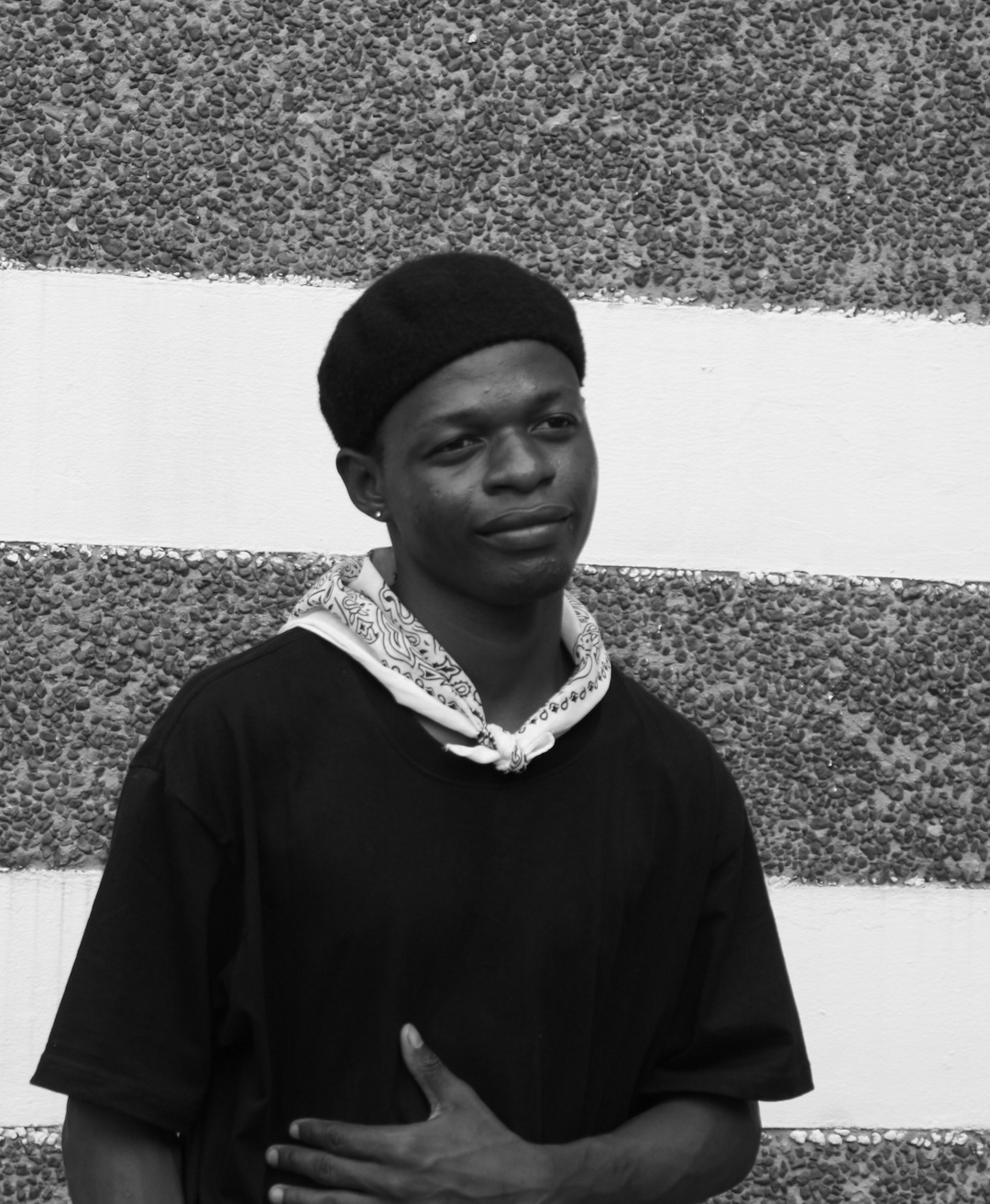

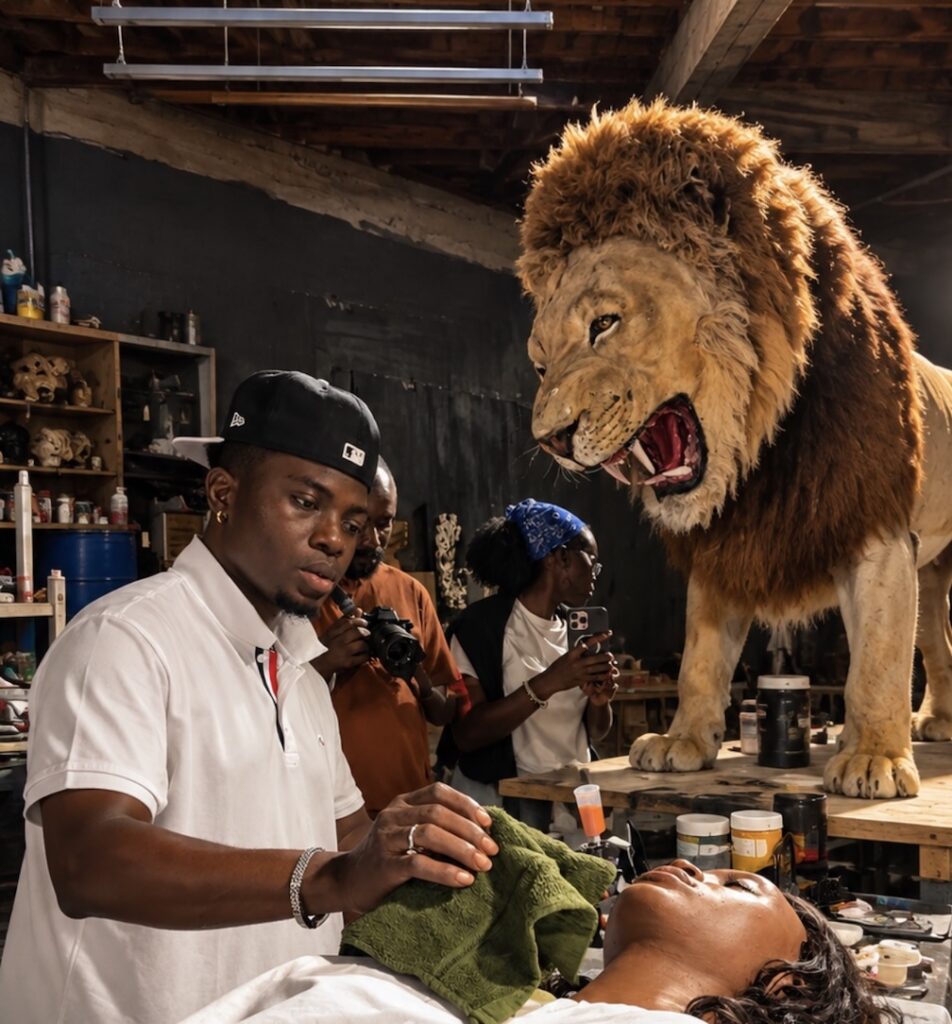
For a man his age, 48, Hakeem “Effects” Onilogbo looks too young. He is dark-skinned and pink-lipped, his face clean and clear, speaking into his phone screen under a shower of bright light. In our 26 minutes together, I playfully wondered if, as he does his clients, he touches himself up, too. If he convinced millions of Netflix subscribers into believing that a 44-year-old actor was a 157-year-old character in Seven Doors, why not a casual self-transformation?
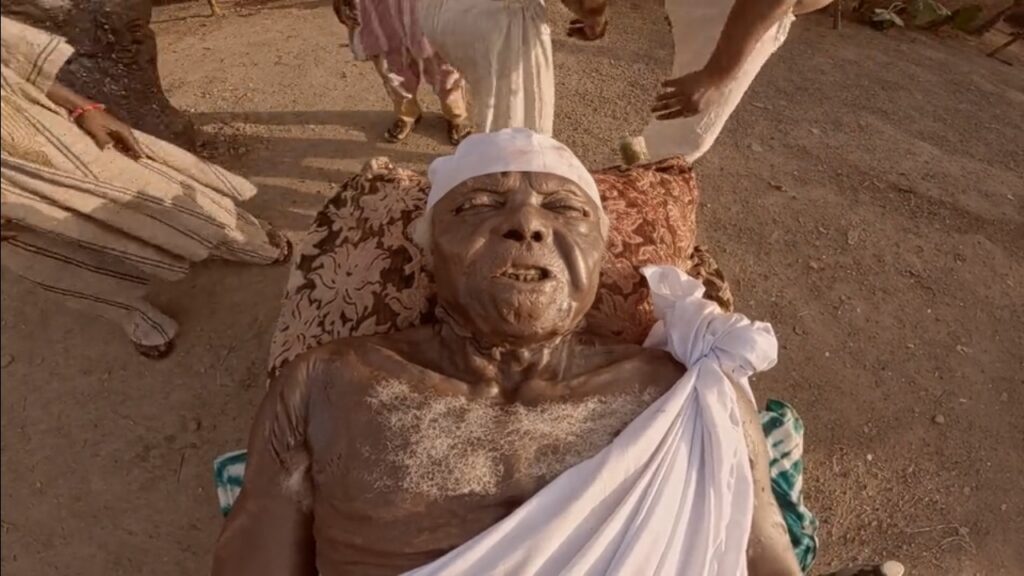
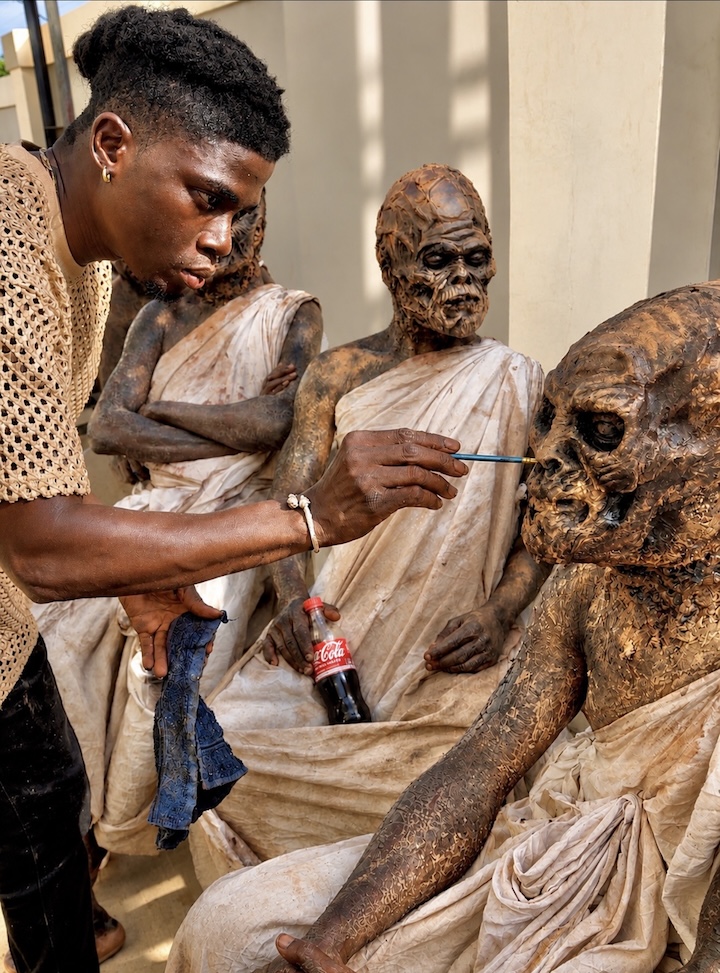
The transfiguration in question happens in the limited series’ fourth episode, “Door Lock.” Oba Adejuwon, a longtime Onilara of Ilara, had sacrificed his seven wives for his aiku, or gbekude, an immortality charm. After passing his 50 destined years on earth, he fell sick and sought death in vain. But he would live an extra 107 years, a reminder of his seven wives’ years on earth, in extreme pain, before he died. He was bedridden, dishevelled, and shrunk, his skin sutured and scaly like a lizard’s, his hairless face tight and pointy, his body shaking like a soaked rat’s — a man betrayed both by life and death. By then he had to be sundried lest maggots infest him.
For seven hours, Kolawole Ajeyemi, the actor who played Oba Adejuwon, sat in the makeup chair while Onilogbo stood, doing back-breaking job. It was tedious for both. Ajeyemi was crying because he could not eat or drink, and air could not penetrate his prosthetics-blocked body pulses.
“You know, in every art, there is room for exaggeration, and the beauty of characterization is to just give it a significant approach, which will put the actor, the character, in the mood, and which will make the audience go haywire,” he told me. “After my findings, and after reading the script, being a talented special effect make artist, I [had] to go the extra mile to add some elements. It is quite challenging and so stressful. I think it is the most challenging transformation I’ve ever done.”
Working behind the scenes has not made Onigbolo a self-effacing artist. He speaks declaratively, without irony. His speech is halting, punctuated with little pauses, fillers, and drags, the phrases and clauses often ending in a rising tone, loud and assured.
“I can readily say I’m the one that changed special effects in the whole of West Africa,” he said in our first interview on Google Meet. I weighed the claim in my head, tempted to ask for elaboration, but also conscious to not disrupt his train of thought. I reached out on Instagram days later and he sent a confirmatory voice note.
“Not just in Nigeria, but West Africa,” he repeated. “Because the way special effects were being done [in the past] is so different from [the way it now is since] when I stepped in. Kudos to the legends that took the baton to that stage before handing it over to me. [But] ever since I started doing special effects, everything [has] changed. People, they had not been doing prosthetics; I am the one that started it. The pyrotechnics — using elements of fire, explosions, and all that — Hakeem Effects started it. [And] a whole lot of things, realistic make-up. So I’m the one that transformed the face [of SFX] before people now started watching what I’ve done, building on the foundation.”
The industry accolades back him up. He has been decking Nollywood movies in film tricks for the past 21 years. He has racked up credits on some of the biggest acclaimed projects in recent years: including the films The Black Book, Jagun Jagun, The Milkmaid, Omo Ghetto: The Saga, King of Boys, and Anikulapo, and the drama series To Kill a Monkey, Shanty Town, and King of Boys: The Return of the King. Crucially, he has a prominent place in awards lore, holding the record of wins in makeup and special effects at both of Africa’s two biggest film awards, the Africa Movie Academy Awards (AMAAs) and the African Magic Viewers’ Choice Awards (AMVCAs).
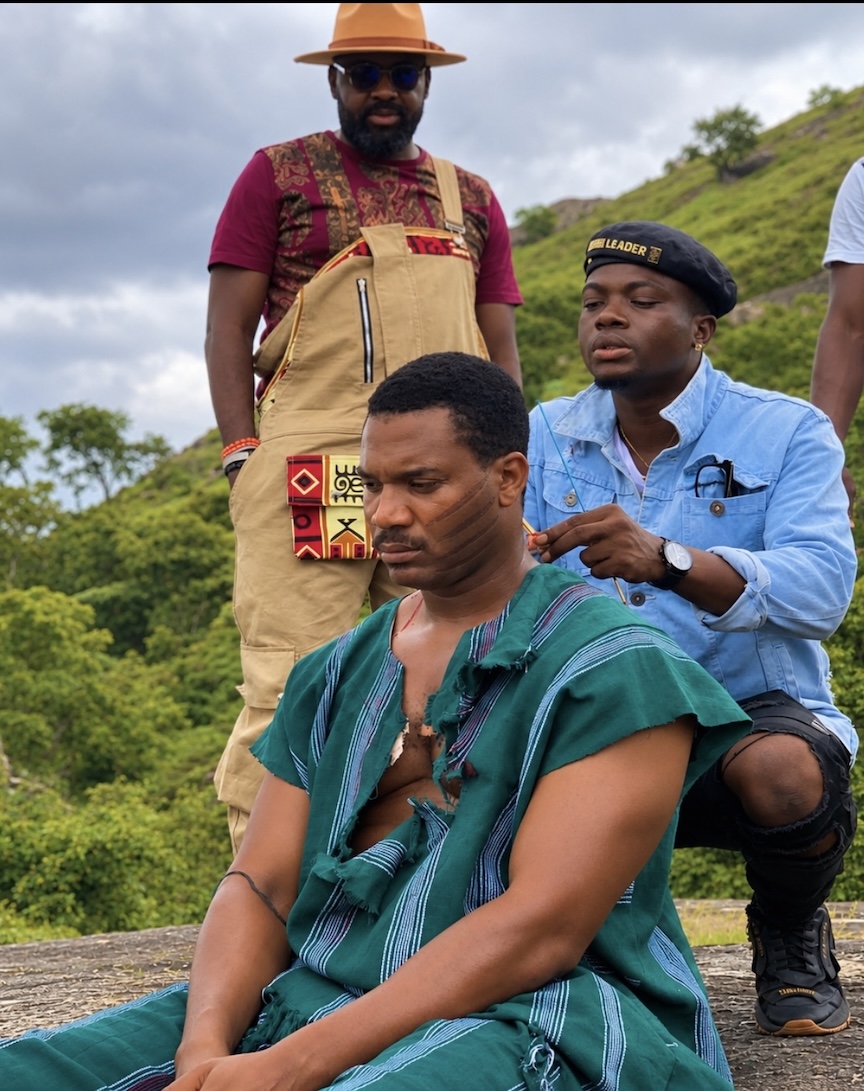
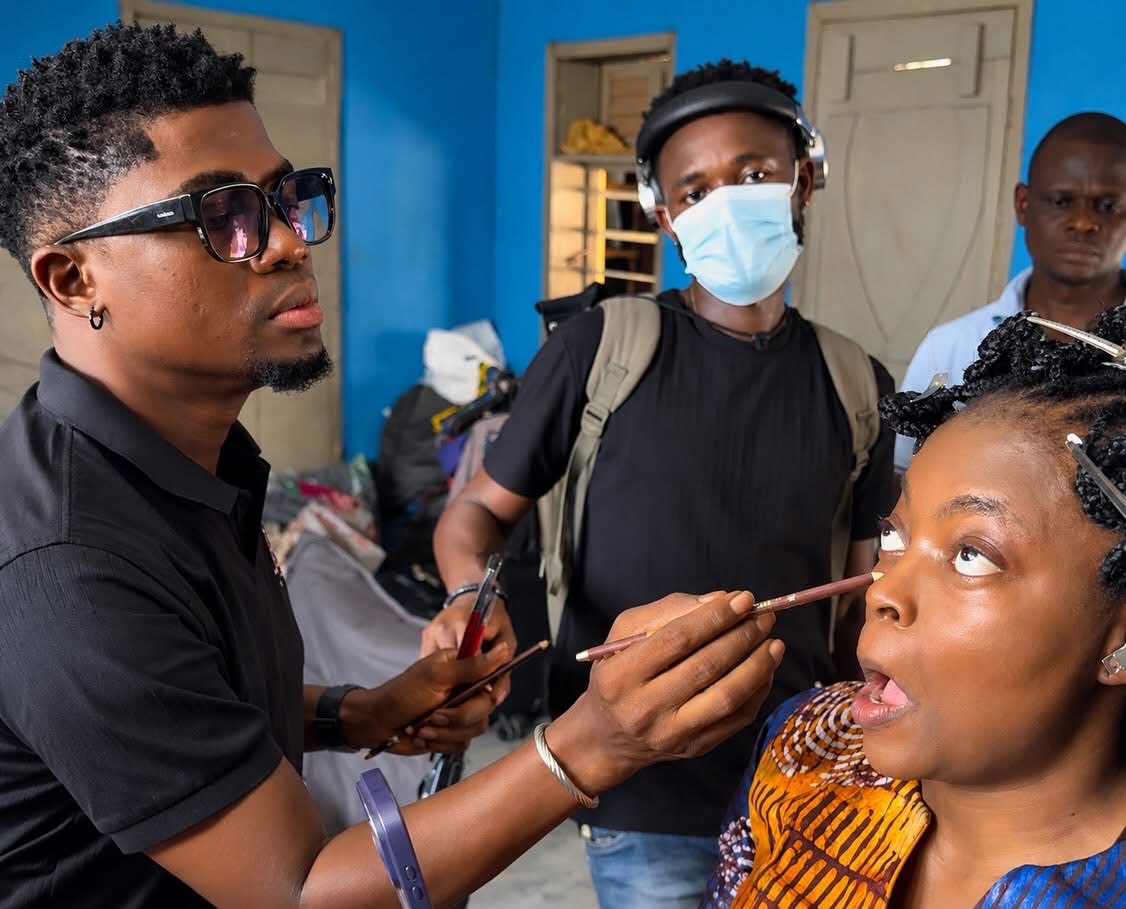
At the AMVCAs, he has won Best Make-up Artist four times: in 2017, for the ecological action thriller Oloibiri (with Perekeme Odon); in 2018, for the adventure Tatu (with Thelma Ozy Smith); in 2023, for the crime thriller Shanty Town (with Maryam Ndukwe); and in 2025, for the Yoruba epic Lisabi: The Uprising. At the AMAAs, he has one Achievement in Visual Effects prize, in 2024, for the Yoruba epic Jagun Jagun; and three Achievement in Makeup prizes: in 2017, for Oloibiri; in 2022, for religious extremism drama The Milkmaid; and in 2024, for the historical fantasy epic Jagun Jagun. His eight wins in the makeup fields is the most in the combined history of both awards.
Onigbolo was describing his impact in response to my question: who and what are his inspirations? Now he gave three names. Rick Baker, who holds the record for most wins of the Academy Award for Best Makeup, with seven; Dick Smith, the American “Godfather of Makeup,” who is said to have pioneered modern prosthetics; and Josh Counsel, the Las Vegas-based master renowned for body painting and custom prosthetics.
The actor-director Ernest Obi, who wrote technically difficult scripts and challenged him to deliver above-par work, made him a perfectionist. He is also indebted to early Nollywood film trick artists, like Dagogo Reeves Diminas, Gabriel “Gabazzini” Okorie, and Perekeme Odon.
“After maybe [the] years I have been ahead, a lot of special effects and makeup artists are starting to rise through what they have seen, through my jobs,” he said. “They are now stepping up their game to the extent that they are so determined. They took the mantle. They are my source of inspiration to move forward. If they are not rising, I will just be stagnant. But seeing them behind me, that they are striving to get to the top — this keeps me going, moving ahead [in] my game. They are such an inspiration for me. And I’m hoping that they are doing well.”
One might explain Onilogbo’s competitive streak from the fact that he first entered the film world wanting to be an actor. His place of birth, Agbokojo, Ibadan, had among its residents legendary Yoruba traveling theatre and film actors such as Chief Adedeji “Olofa Ina” Adeyemi and Musiliu Dasofunjo. In Yemetu Alaadomerin, Ibadan, where his family moved in 1991, lived Moses “Baba Sala” Olaiya, then secretary of the Ibadan chapter of Theatre Arts and Motion Pictures Practitioners Association of Nigeria (TEMPAN). When the family moved again, in 1992, to Abeokuta, it was to the neigbhorhood where the actor Olaiya Igwe had his Olaiya Igwe Theatre Group in full swing.
He joined Igwe’s group in 1992, aged 14, as an equipment handler and welfare boy. There, still hoping to become an actor, he first witnessed SFX. On the set of either Bokorokun or Ore Mi, Olaiya Igwe’s character had to be buried alive and his head cut off. Onilogbo was shocked at the film trick, then called “hard makeup.” He was terrified.
“We had a lot of fantastic actors around then, but I was not comfortable in that space,” he said of his decision to swap careers. “I needed a space where I could exhibit my God-given talent and what Nollywood was lacking then. Perhaps there were [a] lot of special effects people then who were legendary, but there were things that were not being done right. I don’t like to stay in [my] comfort zone. I’m a solution provider, I love providing solutions. That’s why I had to switch. I’m an artist, a painter, so it made it easier for me to, you know, cross over.”
It would take 15 more years for his first real shot at an SFX film gig. When he finally got one, in 2007, aged 29, it was on the Christian film Ilekun Gomorrah, directed by Oreofe Williams. He later worked on a second Williams film: Awo Jesu.
He earned his professional name, Hakeem Effects, while working on the two-part film Osumare, where he put wounds and snakebites on characters and created the anaconda at the heart of the story. There was another Hakeem on the set, and when the producer Murphy Afolabi needed the makeup Hakeem, he added “Effects” to his name. It turned out to be his breakout film.
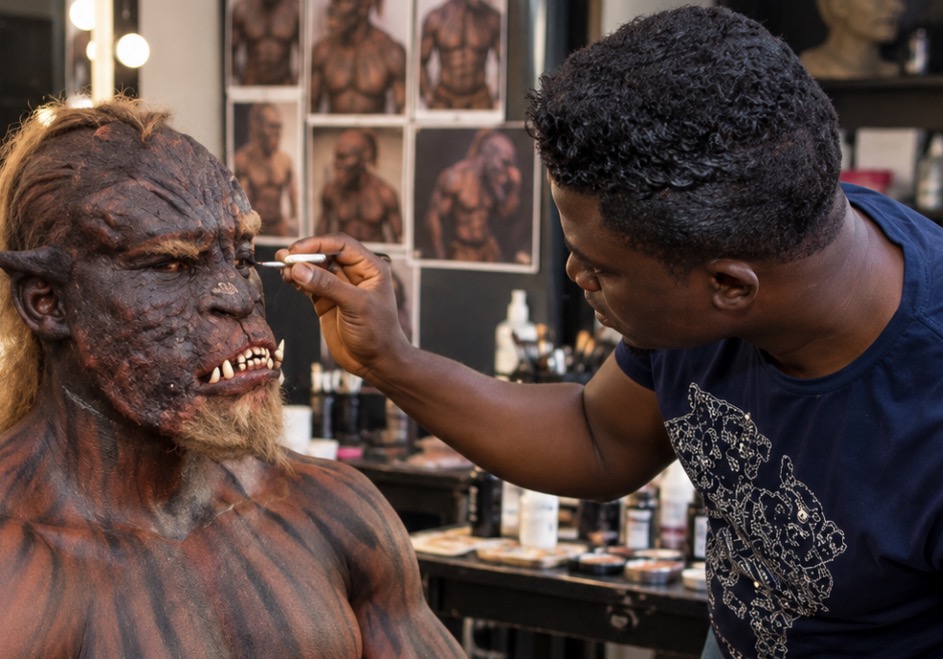
When Onigbolo makes a declaration, one is inclined to hear that he is speaking with the expressiveness of the actor he might have been: ambitious, eyes on the craft. He once said in an interview, in Yoruba: “Eni t’o maa le Hakeem Effects mu, a pass through gbogbo nkan ti mo se yen, gbogbo iya ti mo je yen, gbogbo ise ti mo ko.” Any SFX artist who will best Hakeem Effects will have to pass through all the odds and bits I did, the suffering I endured, will have to learn all the skills I learned.
Since limited time is the final challenge for a makeup artist, one is inclined towards a generous reading of where he is coming from.
It means the years he spent in the mid-2010s, prior to his rise in the industry, collaborating with his wife Eki Osagie, a special effects artist (Finding Me; Beasts of Two World) and his erstwhile trainee, for social media. Osagie’s face and body were the canvass for some of Onigbolo’s viral lifelike transformations: he changed her to Michael Jackson, to Wole Soyinka, to Muhammadu Buhari, to Sam Loco, to Nelson Mandela.
It could mean his rough years even before making it to a film set, when he was part of a Christian drama group called 4GO (For God Only) and tried SFX for the first time. It means the years before 4GO, when he bitterly questioned his father in a letter in 1996, for birthing children — he and three siblings — with no plans to take care of them. Onigbolo ran away to Lagos afterwards. His father, a pharmaceutical company staff member-turned-taxi driver, responded by disowning him.
It may mean his time in Lagos, when he was unable to sponsor his advanced study and was left to his wits, trying his hand at many things, anything, before understudying hand-painted billboard and signage-making at Remi Adesada’s Remmy Art Production Company.
He may be saying, in his own way, that it was that and other menial artistic jobs that prepared him: the times he did carpentry, tailoring, cobbling, welding, and bricklaying, all skills that, eventually, proved useful in SFX. ♦
If you enjoyed what you just read, consider making a PayPal donation to enable us to publish more like it.
No One Covers Nollywood and African Literature Like Open Country Mag
— Inside the Cutting Room of Valentine Chukwuma, Nollywood’s Highest-Grossing Film Editor
— Taiwo Egunjobi‘s Cinema of the Trapped
— Rita Dominic‘s Visions of Character
— The Epic, Transformative Comeback of Chidi Mokeme
— How Leila Aboulela Reclaimed the Heroines of Sudan
— Chinelo Okparanta, Gentle Defier
— The Next Generation of African Literature
— In Dika Ofoma‘s Short Films, the Drama Is in the Mundane
— How Dakore Egbuson and Tony Okungbowa Traverse Trauma in YE!
— With the S16 Film Festival, an Arthouse Collective Locks Its Focus
— How Tolu Obanro, Nollywood’s Top Composer, Crafts the Sounds of Its Biggest Hits
— The Methods of Damon Galgut
— Chimamanda Ngozi Adichie Is in a Different Place Now
— How Teju Cole Opened a New Path in African Literature
— How Mami Wata Swam to Sundance
— With Novels & Images, Maaza Mengiste Is Reframing Ethiopian History
— How Tsitsi Dangarembga, with Her Trilogy of Zimbabwe, Overcame