
Alhaji Àrọ̀lé Agarawu, the paternal grandfather of the poet Adedayo Agarau, grew up in the emergent middle class of the colonial era, in a family with a successful business in cowskins. As a boy, he formed a band with his childhood friend Haruna Ishola, writing songs that showed bright, unruly promise. But when his mother heard of it, she decreed that only “truants and thugs” became musicians and banned her son from that path. He stopped singing immediately. But he did not stop writing music. Ishola would sneak musicians to his door, including another young talent named Yusuf Olatunji, and the boys sat in the living room, or on his bed, and he wrote for them. Ishola and Olatunji would, as adults, become Yoruba musical royalty, orbiting a man no one knew yet.
Agarau’s father, Olajide, transcribed every song his father Arole composed. In their home, Arole paced with his radio and cassette recorder, singing; Olajide drumming on the table; sometimes troupes of percussionists arrived at dawn to turn the house into an impromptu fest of rhythm. Olajide owned a small printing press and his wife ran a sign-writing shop. By the 1980s, he had become a major ghost songwriter, penning some of the famous records of the era for such superstars as King Sunny Adé.
Agarau grew up knowing his father had a good singing voice, and that his younger siblings could have musical careers, but he did not think of himself as coming from a family of artists because none in their bloodline had claimed the word publicly. It was not until 2009, when he discovered a book of poems, that he sought the claim. He was food prefect at Ibadan Boys High School, and a scrawny student nicknamed Fùfù Méje (“Seven Fufu”) was reading a book on the assembly ground. Agarau confiscated the book. Days later, packing for school, he found it again: West African Verse. It had poems by J.P. Clark, Leopold Senghor, and Niyi Osundare. They primed in him a love for language. He walked into his family’s printing press. As the jaws of machines chomped, swallowing blank A4 paper and spitting them out patterned, he sat with the pages, collating rhymes that morphed into rap verses, which he shared on Facebook and entered for rap battles.
When he told his father that he had published his first poem, the man nodded, unsurprised, because he’d expected his son to follow the family calling. His relatives, amused by his turn to writing, often told him, “You are your grandfather’s grandchild.”
Agarau told me, “Maybe this thing is passed down, you know? It might skip a generation but then it would land suddenly on another.”

We spoke on Zoom last fall, while Agarau was in Los Angeles. The sun, full and unforgiving, poured in through the blinds beside him. He had left Nigeria to study at the Iowa Writers’ Workshop, and later at Stanford University, where he was a Stegner Fellow. It was a detour for someone who studied Nutrition and Dietetics at Federal Polytechnic, Ede, and at Rufus Giwa Polytechnic, Owo. At the time we spoke, he was pursuing a PhD in Creative Writing at the University of Southern California (USC), and our conversation thickened around his transnational literary life and the conversations happening back home. Geography has never been the organizing principle of his poetry, although the Nigerian sensibility has: its clinical attentiveness to pain, its socio-cultural urgency.
He pushed back against the idea that writing produced outside Nigeria was less Nigerian. “You know, I always say that when someone is writing about living in the U.S. or in Los Angeles, they are writing that experience as a Black man, as someone with different roots. So the poetry is very Nigerian, because that is where it’s coming from.”
His first chapbook, For Boys Who Went, published in 2016, echoes the inherited burdens of masculinity, the violences boys learn to carry early on. In the then small but growing Nigerian online poetry scene, it became one of the most-read chapbooks, with over a thousand downloads on Arthorpedia, a platform owned by Kukogho Iruesiri Samson, who was also responsible for launching several other notable poetry careers. “I became that guy,” he chuckled, “the one who would write a poem, and suddenly everyone was writing their own version with the same title.” His uncles, uninterested in literature, began calling him For Boys Who Went.
In an interview with his former mentor Samson for A CỌ́N-SCÌÒ Magazine, he reflected on the exposure from the chapbook: “The popularity gave me a sense of responsibility to my audience and the work itself. It encouraged me to think more deeply about the narratives I wanted to tell about fathers, absences, and loss, and the voices of sons and boys I wanted to center. It also sharpened my sense of what it means to write from and for a place of cultural specificity. . . I just wanted to write a collection that mirrors us as children. The poems in For Boys Who Went also dealt with grief, familial memory, and childhood — themes that have since become central to my practice.”
One of the chapbook’s most resonant pieces, “end,” gives a near-blueprint of the emotional architecture he would refine:
we were boys
learning to throw ourselves to the world
like our kites dangling to wind songs
in the terrain of blue skies
we were tired boys
knitted to our father’s names.
The poem casts boyhood firmly in the past tense, its losses aggregating into the slow darkening of “we must beat with torchlight.” Boyhood is tender as it is estranged: boys dreaming upward into the “terrain of blue skies,” yet “knitted” to their fathers’ names and, by extension, their fathers’ failures. The early contour of Agarau’s voice was attentive to the emotional labor expected of boys.
Boyhood and loss continued in his later works: The Origin of Name, published in the African Poetry Book Fund’s New Generation African Poets chapbook box set in 2020; The Arrival of Rain, appearing the same year from Vegetarian Alcoholic Press; and, most recently, his full-length collection The Years of Blood, released by Fordham University Press last year after it won the Poetic Justice Institute Book Prize and he himself picked up the C.P. Cavafy Prize.
When we spoke, Agarau had just been named a finalist for the Future Awards Africa Prize in Literature. “It feels like a full-circle moment for me to be on the list with people I have worked with,” he said. Three weeks later, the circle completed itself: he was announced the winner, the third writer to claim the honour after Otosirieze in 2019 and Logan February in 2020.
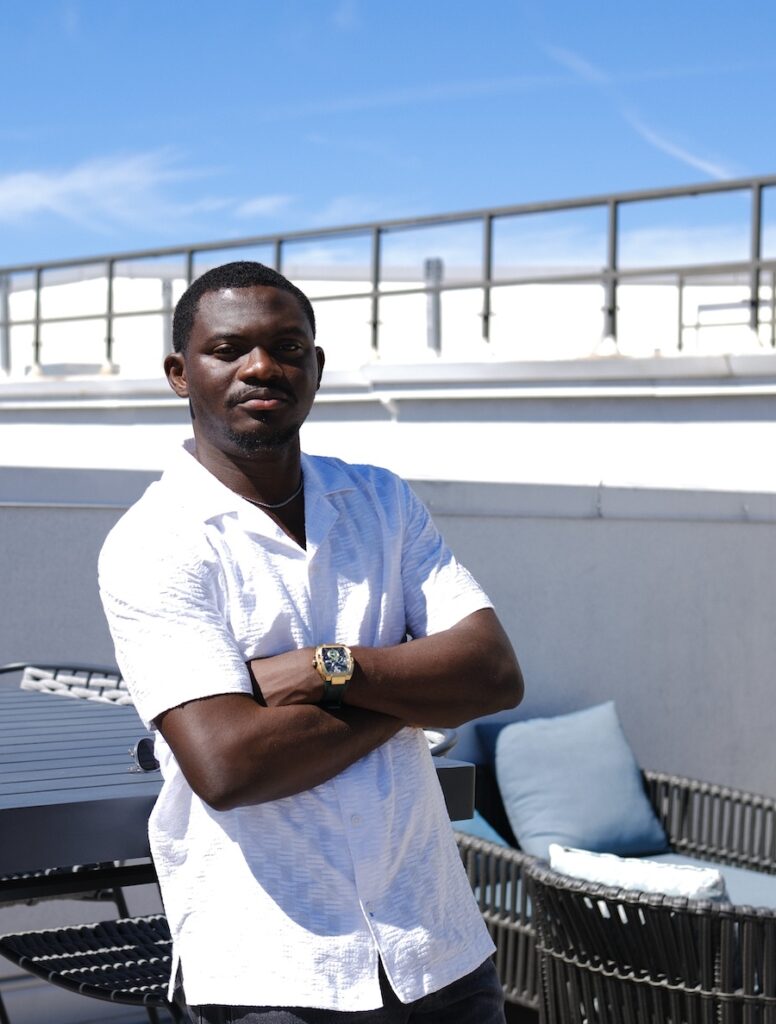
Agarau’s appetite for language began to bolster in a rather strange place: a 2go chatroom. “To be honest, 2go was where we went to talk to babes,” he said. Then he had found himself in a chatroom called Poetry, where a handful of young Nigerians, unironically speaking Victorian English, held nightly salon sessions. He read their chats, marveled by their contortion of language. One evening, he arrived in time to find Rasak Malik and Chisom Okafor, two poets whose lyrical and metaphorical ranges still make him swear under his breath, typing poetic lines into the room.
Through Malik, he gained entry to Words, Rhymes, & Rhythms (WRR), the Facebook literary community hosted by Samson. Agarau revisited their old chats recently. “My grammar was terrible back in 2012,” he told me, amused, “even though I thought I spoke good English.” What mattered was that he reached out to Samson for mentorship and Samson said yes: “I told him, ‘I need you to be my mentor.’ He asked how far I was willing to go. I said, ‘As far as you take me.’” From there, Agarau churned out work alongside other writers like James Ademuyiwa, Gabriel Ayomide Festus, Ridwan Adelaja, Vica Dex, and Adetimilehin. “Every day we showed up. Every day we wrote. And there was no world telling us we were poets. We just were.”
Agarau added, “There probably would not be an Adedayo if Kukogho Iruesiri Samson had not published my first poem. I’m thinking of myself as somebody who can possibly lead a community, but there would be no community if I didn’t have a place there to begin with; if somebody had not told me that I could do this. There will be no community if when I started writing, I was writing in a vacuum.”
The solidity of community kept him going, attending readings and poetry slams as they sprouted across the country. In 2013, when the poet Tade Ipadeola won the NLNG Prize, Agarau was in the crowd at Artmosphere, hosted by Servio Gbadamosi and Femi Morgan, shaking in his boots as Morgan called him up to read. When he was invited to #BeBlessed, hosted by Olumide Bisiriyu, his mother sewed him an Up-Nepa buba and sokoto for the event. He and 30 other young writers gathered in Bisiryu’s home, mornings lit with earnest conversations on poetry as they snacked on bread and fried eggs and tea.
In a 2024 essay “What in the World is Happening in Nigeria?”, he captures the experience of being a young writer then:
I was a writer that year. That was all that mattered — being a writer . . . Looking back, I am struck by our fervent desire for growth, which I now realize was born out of the lack of formal institutions. Without established structures and the generosity of older writers willing to throw a few thousand around, we became our own mentors, critics, and champions. We were all we had, and in that scarcity, we found abundance.
After assuming editorship of Agbowó, he and six other poets — Agbaakin Jeremiah, Adebayo Kolawole, Pamilerin Jacobs, Michael Akuchie, Wale Ayinla, and Nome Emeka Patrick — launched the UnSerious Fellowship, which offers financial and editorial support for poets. The collective produced an anthology, Memento, published by Animal Heart Press in 2020. Agarau served as a chair of Poetry Sango-Ota, edited by Akuchie and Jakky Bankong-Obi, an archive spotlighting Nigerian poets.
“One thing that I owe Nigeria is to come up with opportunities for other people,” he said. “Any space I get into, I make sure that, as I’m leaving, another Nigerian or an African is coming there. I walk into rooms with names. I’m never afraid to share. I introduce my own professors to people who have not even published a book.” In a class during his Stegner Fellowship, he asked how many African poets other Fellows had read. No one named more than three. “It made me realize there was so much work to do.”
Some of that work meant $10 giveaways on X, to coax people back into the practice of writing. “Twitter is dead to literature right now,” he said. “I don’t even know where to start if I’m going to go back to Facebook and try to strike something back. I don’t know how to do it. But it’s wild, because a lot of people no longer write. We need to create a system where people know that there’s something to aspire to as a writer. Statewide or local-government-wide poet laureate programs.”
This year, he announced the Alhaji Àrọ̀lé Agarawu Prize for African and African diasporan poets, named after his grandfather. He wants it to have real prestige, a prize that “unlocks doors for emerging writers,” from publication opportunities to strong recommendation letters.
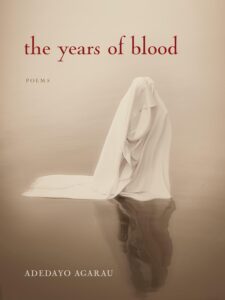
Agarau did not plan for his first full-length collection, The Years of Blood, to confront his personal history in a stark way, unpeeling layers of memory and spirituality. The earliest and opening poem came on his flight out of Nigeria in 2021. Somewhere between Lagos and the sky, repressed childhood traumas came in a rush, and he put them in “Ibadan”:
& when they found me i was standing by a NEPA pole insensible the window of grief that opened in my family shut itself and opened in a house down the street children began to die then
It was the first time he wrote openly about the uncle who killed his aunt for rituals. “I could not write about these things before,” he said. “I cared about my family, about safety.” Distance made the truth writable.
The activating word in Agarau’s work is “boy.” Years after For Boys Who Went, he found himself returning to kidnapping, communal fear, and the violences of childhood in Ibadan, a city where “everywhere weed grows is a mouth swallowing children,” and grief is less an event than a migratory bird perching on rooftops, hungry.
He grew up on Ogunleye Street, a short walk from Liberty Stadium, an area known for child disappearances. At a point he, too, was abducted, folded temporarily into the city’s shadow economy. A classmate, Taofeek, came to school one Thursday morning and never returned. His remains were found in a bush near his father’s house on Joyce “B” Road.
The neighbourhood was active. Fathers took shifts keeping watch. Tires smoldered at the street corners, a crude alarm system powered by fear. They lived in communal flinch, rehearsing loss before it arrived, grieving it again when it did. It didn’t help that, at school, communal fights erupted without warning and boys swung cutlasses at each other in a bid to survive. A classmate strapped charms beneath his shirt, a belt of spiritual protection.
On the streets where he sold candles after school, the boys played football and one girl, Yetunde, joined them as their goalkeeper. The absence of gender categories still puzzles him.
“We were just children. We were just having fun,” he said. “The aunties in our area started pitting us against each other. You are a boy. You are a girl. Kiss this one.”
He knows that “boy,” as his keyword, is imprecise and flattens things. But he and those children grew up inside a structure that assigned masculinity early and violently. “The masculinity of emotion. Oh, be a man. Don’t cry. Boy as metaphor functions on the spectrum of survival.”
Agarau has said that The Years of Blood places boyhood and its emotional scaffolding “in the backdrop of political restructuring.” It links the pursuit of power and money to body parts ritualism. “We have seen people get hacked in real life. We’ve heard news of women whose body parts were harvested and left on the street. I also grounded in the collection that what the West considers as speculative is everyday African life.”
He describes in “Sọ̀kà” how ritual violence is part of the terrifying normalcy through which power circulates:
A machete cutting deep through
the bones of a child
is someone else’s answered prayer.
The real Sọ̀kà was dubbed the “Ibadan forest of horror,” a place where poverty, political ambition, and ritual economies tangle. In 2014, authorities found the abandoned site with survivors chained in rooms, decomposing bodies in shallow pits. For many Nigerians, Sọ̀kà confirmed that the kidnappings, disappearances, and ritual killings were part of a shadow political network. It extended the haunting of a nation learning to live with the knowledge of its own unseen rooms.
Throughout these horrific vignettes, Agarau threads Yoruba in a near-incantatory register, invoking ethereal forces and the metaphysical cadences of ritual. The language moves with a pulsating fervor, calling on God and the self. He put it this way to A CỌ́N-SCÌÒ Magazine: “Yoruba impresses itself on you. If you once lived the language, you live the language forever. I cannot think of myself without my mother tongue.”
In this sense, what his fathers gave him, he refined with what his mothers gave. Like with language, he derived the faith impulse in his work from the age-old Yoruba accommodation of spiritualities. His grandparents, paternal and maternal, were all Muslim. His maternal grandfather moved between the mosque and the duties of a traditional chief priest. His paternal grandmother, Alhaja Sikirat Agarau, shifted so fluidly between the local Islamic and Christian communities that both took her as one of their own and the Anglicans made her a deaconess.
He sees the linguistic grounding of his work as inseparable from its spiritual architecture. “Faith is the time we spend waiting,” he told Compulsive Reader last year. “Whether in the poem, in prayer, or even in the act of watching, as fathers kept vigils and burnt tires all night, sharing bottles of gin and telling each other stories. How could we have survived these years of blood without the delusion that the gods would keep us safe?” ♦
If you love what you just read, please consider making a PayPal donation to enable us to publish more like it.
More In-depth Stories from Open Country Mag‘s The Next Generation Series
— Afabwaje Kurian Grows Her Gbagyi Roots
— In Great Grief, Mubanga Kalimamukwento Saw Zambia
— JK Anowe, a Confessional Poet, Confronts Himself
— The Prodigious Arrival of Arinze Ifeakandu
— Aiwanose Odafen‘s Duology of Womanhood
— Momtaza Mehri’s Fluid Diasporas
— The Overlapping Realisms of Eloghosa Osunde
— DK Nnuro Finds His Answers
— How Romeo Oriogun Wrested Poetry from Pain
— Suyi Davies Okungbowa Knows What It Takes
— Why Tobi Eyinade Built Rovingheights, Nigeria’s Biggest Bookstore
— Remy Ngamije on Doek! and the New Age of Namibian Literature
— Ebenezer Agu on 20.35 Africa and Curating New Poetry
— In Writing Cameroonian American Experiences, Nana Nkweti Crosses Genres
— Oghenechovwe Donald Ekpeki‘s Curation of African Speculative Fiction
— Logan February on Their Becoming
— The Cheeky Natives Is Letlhogonolo Mogkoroane and Alma-Nalisha Cele‘s Archive of Intentionality
— Cheswayo Mphanza on Intertextual Poetry and Zambia’s Moment
— The Seminal Breakout of Gbenga Adesina
— Keletso Mopai Owns Her Story and Her Voice
— Troy Onyango on Lolwe and Literary Magazine Publishing in Africa
— At Africa in Dialogue, Gaamangwe Joy Mogami Lures Out Storytelling Truths
— Khadija Abdalla Bajaber on Fantasy and the Character of Kenyan Writing
— TJ Benson Holds History and Hope