
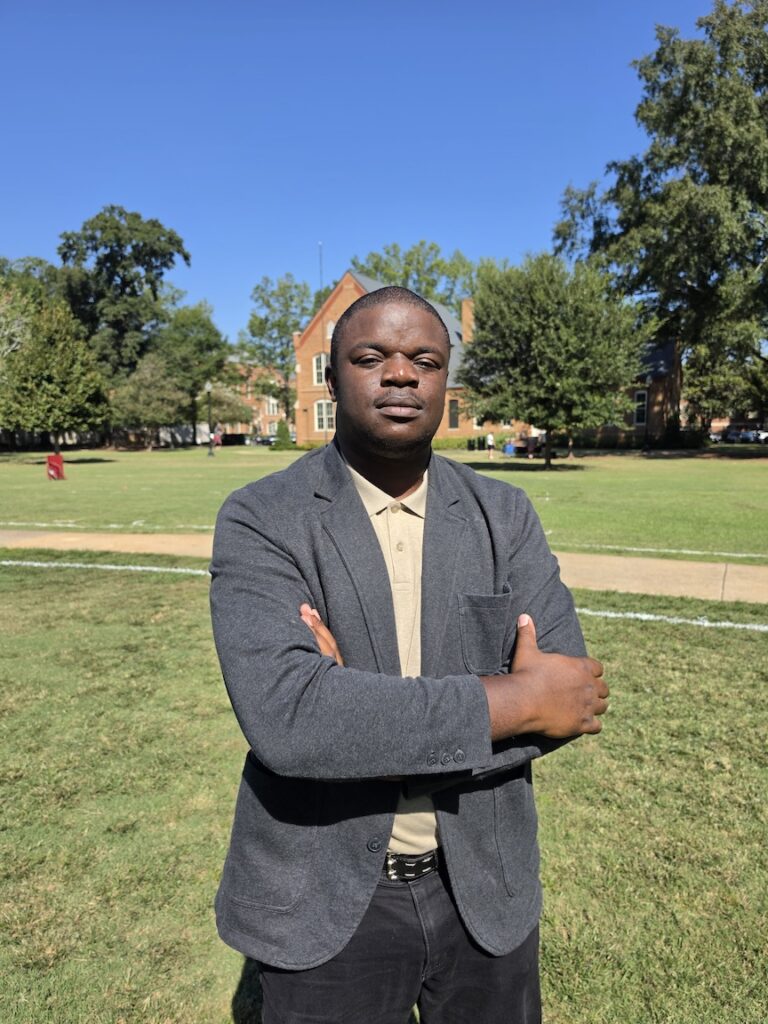
One suspects that Chisom Okafor, the poet and nutritionist, does not experience scientific observation and artistic creation as separate enterprises. When he broke down his fascination with language to me, he dipped, instinctively, into the lexicon of physics. “The page is like a force field,” he demonstrated with his hands. “Words behave like molecules in heated water. They collide with one another. They collide with the page.” He understands poetry with the curiosity of a scientist. Where many writers speak of intuition, he speaks of methodology. “I like to have hypotheses, and then a theory, and then a law, and then a principle.”
It explains why, for much of our conversation, he spoke about illness with the ease of someone discussing the weather, and one almost forgets that he is describing an event that fundamentally reorganized his relationship to time. In 2015, in a Human Nutrition and Dietetics class at the University of Nigeria, Nsukka, he and his peers were learning to use diagnostic equipment. They divided themselves into groups and practiced on one another, testing for blood glucose and blood pressure, the rituals of clinical training. The readings produced nothing remarkable until it was Okafor’s turn. His blood pressure was unusually high. The reaction, at first, was almost casual. “This guy has hypertension!” they joked.
Later, hospital visits revealed that the hypertension had gone undetected for years. Part of his heart was enlarged from the strain. Other patients in the cardiology clinic were old enough to be his parents and grandparents. Hospital workers assumed he had come on behalf of an older relative. They did not expect their patient to be 21. For the first time, mortality became an immediate concern for him.
“I could see it,” he told me. “I could have died.”
Like many young people confronting chronic illness, he struggled with the idea of permanence. Medication belonged to malaria, typhoid, temporary inconveniences with predictable endings. Hypertension was different. No obvious conclusion. He hated the drugs. During his National Youth Service year, his father bought him boxes of medicine, but he refused to take them.
“I was tired,” he said. “I didn’t want to take medications all my life but somehow I had to just go back to it because I realized that the only thing giving me a sense of purpose was poetry.”
In an interview with Isele Magazine, he described the inconvenience and uncertainty: “I literally go to sleep . . . without expecting to rise with the sun, and then I wake each day, expecting to die in the course of the day, expecting to have a heart attack or a stroke. I’ve taught my family and friends how to perform CPR, because I suspect they would soon need the skill that this medical procedure requires, to try to revive me, and though I wouldn’t wish to be resuscitated, they may need this knowledge for someone else.”
While completing an internship at the University of Nigeria Teaching Hospital, he emailed a friend, the poet J.K. Anowe, with a startling request: I have a few poems I’ve written. In case I die, publish them for me. The diagnosis had already altered his sense of the future. Anowe, unsurprisingly to him, refused that premise. He told him he would be fine. The poems survived. So did he.
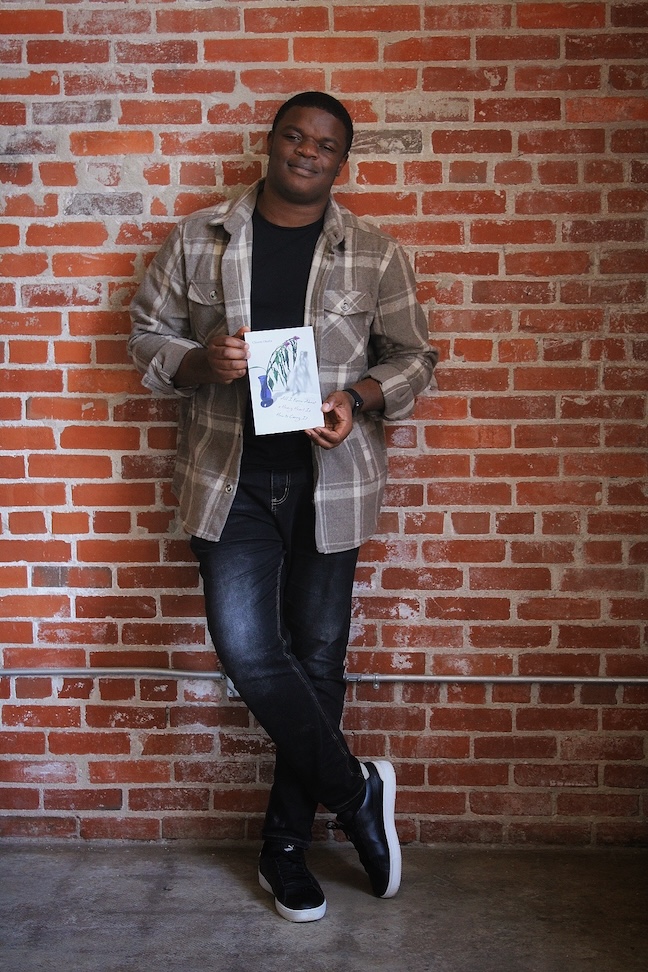
Many of those poems made their way into his first chapbook, All I Know About a Heavy Heart Is How to Carry It, which won the Jacar Prize in 2024. In his framing, the body is fragile, unpredictable, capable of betraying its owner without warning. He writes in the title poem:
But all I know
about an enlarged heart is the angina painsthat linger through nightfall and
far into the morning after.
Language and food mixed early in Okafor’s life. His mother, a teacher, brought home a children’s series called Garden Gang. The details stayed with him: characters named after fruits and vegetables, talking plants moving through small adventures and predicaments. He recounted them to me, with the immediacy of an unspooling film reel. After his mother’s passing in 2000, his older brother provided the books, borrowed from the school library. Oliver Twist. Gulliver’s Travels. Children’s adaptations of the classics. To him, stories were less objects to consume than places to inhabit.
“I was a very quiet child but also curious,” he told me. “If I come to a place where there are so many people around, you wouldn’t know that I was there, but I would catch every single thing they are talking about.”
One day, as a freshman in Nsukka, he wandered into the Faculty of Arts building, and at the Department of English, he saw a noticeboard belonging to The Writers’ Community (TWC). There were stories and poems by writers he soon grew fond of: Arinze Ifeakandu, Ifechukwu Pius, Otosirieze Obi-Young. He stood reading.
“These are the guys I wanted to be like,” he recalled.
On weekdays, he attended classes in Human Nutrition. On weekends, he disappeared into The Writers’ Community meetings at the Faculty of Arts quadrangle. Once, he forwent a lab practical exam just so he could attend a writing workshop led by Chika Unigwe, who at the time had just won the Nigerian Prize for Literature.
The Writers’ Community was also where I first met Okafor in 2021. By then, he had become one of those names that circulated with unusual frequency among young writers, with the distinction of having been a finalist for every major prize that recognized poetry: the Brunel Poetry Prize, the Sillerman First Book Prize, and the Gerald Kraak Prize. I was 19 then, a second-year undergraduate still trying to locate myself within literature, and I arrived at the workshop he was teaching with my notebook, ready to jot down the essentials of the craft.
I remembered that workshop most by the quality of his movement, the velocity of him. The man before me seemed animated by a different physics altogether. He spoke in digressions, laughed at his own tangents. A story opened into another. An observation generated three more. Ideas arrived in clusters. It was like watching thought happen in real time. He said he had “fallen in love with the intricacies of language.” I wrote the sentence down. I shared the belief that if one paid close enough attention to writers, their enthusiasms might become contagious.
After the workshop, I returned to my hostel and looked him up. I spent the evening moving from one online literary magazine to another, reading whatever poems of his I could find. The poems came as a surprise. Their exuberance gave way to something measured. Here was a poet attentive to absences: to grief as much as love, to memory, to the subtle negotiations between the body and its vulnerabilities, his restless energy distilling into something more exacting.
A few days later, I sent him a message on Facebook. I told him how much the poems had meant to me and asked if he might recommend some reading. There was no reason to expect a response. Writers, as far as I understood them then, belonged to a distant category of people whose lives happened elsewhere. A week later, an email from him appeared in my inbox. Inside were six poems and a brief note. I remember opening the message and feeling sincerely elated. Until then, writing, for me, had been largely solitary. And that may not have become apparent to me had Okafor not been so generous and his work so focused on community.
In Lagos, he established the Yaba Connect Center of Poets in Nigeria (PIN), bringing young writers together monthly to discuss their work. He mentored several more through the SPRINNG Writing Fellowship, and, after coming to America for an MFA at the University of Alabama, he volunteered at the school’s Young Writers Camp. As an editor at Libretto Magazine, he told me, he focused on young poets who “write from what you may call the fringes or peripheries of literature . . . people who, like me, came to poetry from the sciences or with no formal academic background in the arts.”
His clinical and literary lives have also converged on the page. In 2024, he served on the advocacy and advisory panel for the anthology Versus Versus: 100 Poems by Deaf, Disabled and Neurodivergent Poets. His work was on “the representations of the spectrums of disability in Africa,” he said. “I want to ensure that young African writers who are disabled, chronically ill, or neurodivergent participate in the ongoing global conversations around disability poetics, its intersections with the culture of care, cure, and African spirituality.”
His poem, “In another life, I am twenty-two, gifted and curious,” which appears in the anthology alongside works by other African poets, including Kwame Dawes and JK Anowe, imagines a self split between the longing for escape and the inevitability of embodiment. One figure waits at the far end of the sea, but the other is trapped in the body, seeking to comprehend “the exquisite mathematics of drowning.”
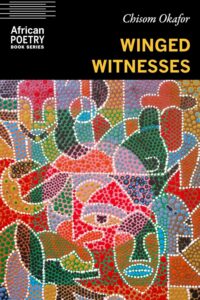
In his teens, Okafor taught catechism classes and spent considerable time reading about the saints. At some point, he encountered a phrase that lodged itself permanently in his mind: a “cloud of witnesses.” He could see it, he told me. Saints suspended overhead, winged presences gathering around the living. He tinkered with the image and came up with his book title: Winged Witnesses.
But Okafor’s witnesses in the collection, published by the University of Nebraska Press, are not celestial observers. They are lovers witnessing love. Fathers witnessing loss. Patients witnessing illness. The self witnessing its own fragility. “What is poetry really,” he asked me at one point, “if not the act of witnessing?”
That quality of attention is deliberate. His poems watch carefully. They listen to the body’s uneasy accommodations with suffering. They flourish in scrutiny, in the minute shifts of feeling and perception that precede understanding. Among their objects of focus is death, observed in its ordinariness. In parlors, on sofas, on casual evenings. Mortality becomes a presence, a companion sat in the room.
In “Echo-cardio-gram,” the speaker contemplates it through the image of an owl, a creature whose movements remain opaque even to itself:
Just as an owl dies, knowing nothing of the etiology
Of its nocturnal fondness, why only in empty darkness is where it finds home.
But we misinterpret emptiness as guilt,
Which is why the owl is a curious creature to us.
The lines unfold diagnostically even as the poem probes what it means to inhabit a condition one cannot fully explain. Why do we move toward certain darknesses? What parts of ourselves remain inaccessible even to us? Such questions rock the core of his work, where witnessing happens organically within the poem’s habitat.
This proximity to death brings his poems, repeatedly, to moments where the body reveals itself as precarious, as capable of radically changing course. In “On Breaking the News on My Heart Dysfunction,” he writes:
This is my most preferred posture of departure
to fall asleep on a sofa
and forget the moment of my awakening.
The book’s structure — with two sections, “First Witness” and “Other Witness” — feed this reading of attestation. In the first, the speaker faces inward, bearing witness to himself, to the body, to illness, to desire, to the private upheavals of the heart. In the second, the gaze widens. Fathers, lovers, grievers, and other personas enter, each carrying their own losses and longings.
Yet it was not until our conversation that I understood this architecture more. The movement between its sections is a gradual expansion of attention from self to the other. It is the heart, which dominates the poems in a physical, metaphorical, enlarged, and broken way, opening into other lives, other griefs, other ways of inhabiting the world. The witness multiplies.
Such hallmarks of human observation — hovering above events while being implicated in them, forever travelling between worlds and returning with reports from each — such impulse towards testimony would naturally be attentive to negotiations of vulnerability and concealment.
In his 2019 poem “A Shorter Note on My Coming Out,” the speaker moves through the precarious realities of queer existence in Nigeria — “Pray the police don’t catch you making love to a man” — testifying to lives under pressure, the accommodations survival demands and the private costs they exact.
“Poetry carries the micro-histories of the heart,” Okafor said to me. “I want my work to give people a companionship of loss. Not to answer the questions they have about loss but to accompany them in their search and questioning.” ♦
“Chisom Okafor’s Human Observations” appears in The Next Generation, a special series of Open Country Mag, profiling rising younger writers and curators in African literary culture, curated and edited by Otosirieze Obi-Young. The groundbreaking first issue, featuring 16 voices from seven countries, was released in April 2022.
If you love what you just read, please consider making a PayPal donation to enable us to publish more like it.
More In-depth Stories from Open Country Mag‘s The Next Generation Series
— What Adedayo Agarau Got from His Fathers
— Afabwaje Kurian Grows Her Gbagyi Roots
— In Great Grief, Mubanga Kalimamukwento Saw Zambia
— JK Anowe, a Confessional Poet, Confronts Himself
— The Prodigious Arrival of Arinze Ifeakandu
— Aiwanose Odafen‘s Duology of Womanhood
— Momtaza Mehri’s Fluid Diasporas
— The Overlapping Realisms of Eloghosa Osunde
— DK Nnuro Finds His Answers
— How Romeo Oriogun Wrested Poetry from Pain
— Suyi Davies Okungbowa Knows What It Takes
— Why Tobi Eyinade Built Rovingheights, Nigeria’s Biggest Bookstore
— Remy Ngamije on Doek! and the New Age of Namibian Literature
— Ebenezer Agu on 20.35 Africa and Curating New Poetry
— In Writing Cameroonian American Experiences, Nana Nkweti Crosses Genres
— Oghenechovwe Donald Ekpeki‘s Curation of African Speculative Fiction
— Logan February on Their Becoming
— The Cheeky Natives Is Letlhogonolo Mogkoroane and Alma-Nalisha Cele‘s Archive of Intentionality
— Cheswayo Mphanza on Intertextual Poetry and Zambia’s Moment
— The Seminal Breakout of Gbenga Adesina
— Keletso Mopai Owns Her Story and Her Voice
— Troy Onyango on Lolwe and Literary Magazine Publishing in Africa
— At Africa in Dialogue, Gaamangwe Joy Mogami Lures Out Storytelling Truths
— Khadija Abdalla Bajaber on Fantasy and the Character of Kenyan Writing
— TJ Benson Holds History and Hope